Download
1 / 9
90 likes | 216 Vues
This chapter delves into fertilizers, essential materials added to soil for nutrient supply, including organic and inorganic variants. Organic fertilizers enrich the soil with macronutrients like nitrogen, phosphorus, and potassium (NPK), while inorganic fertilizers offer a mix of salts providing macro- and micronutrients. The discussion covers fertilizer grades, soil analysis, and the impact of overuse on environmental health, including pollution risks. The effective timing of fertilizer application for optimal plant growth is also highlighted, ensuring sustainable agricultural practices.

E N D
Fertilisers Chapter 7
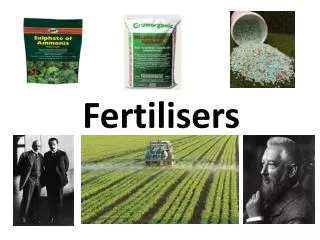
Fertilisers • any material added to soil to supply one or more nutrient elements: • organic or inorganic • natural or synthetic • necessary to maintain fertility because of intensive cropping • organic fertilisers have the macronutrients – especially the key three N, P and K – but also organic matter which enriches the soil • inorganic fertilisers, which are generally more processed, only provide the macro- and micronutrients Soil Analysis Ch7
Inorganic • a mixture of salts of the various nutrients • N:P:K grade is an important measure • the %w/w of the three elements (with P expressed as P2O5 and K expressed as K2O) • does not actually contain these forms of P and K • the standard way of reporting their levels • eg a fertiliser with a grade of 10-6-8 is composed of 10% N, the equivalent of 6% P2O5 and the equivalent of 8% K2O. Soil Analysis Ch7
x 0.44 %P ÷ 0.44 Fertiliser Grade ÷ 0.83 %K x 0.83 Conversion between % Class Exercise 7.1 • A fertiliser has a grade of 14.1-8.2-10.3, What are the actual levels of N, P and K? • %N = 14.1, %P = 8.2x0.44 = 3.6, %K = 10.3x0.83 = 8.5 Soil Analysis Ch7
Exercise 7.2 Soil Analysis Ch7
Commercial grade • complete – have the full set of macro- and micronutrients, • trace element mixture – micronutrients only • specific plants – formulations for plants requiring nutrients in different proportions to normal • slow release • soluble – all components are soluble, providing a quick tonic for plants, but one that is readily lost by leaching Soil Analysis Ch7
Organic fertilisers • Natural material, principally manure, is both: • a mulch – a slowly decomposing organic cover over the soil to retain moisture – and • a source of nutrients • NPK grade of fresh animal manure is typically around 10:5:10 • increased after drying (less water) • different for different animals • addition of organic matter to the topsoil is probably as important in manure fertilising as the provision of elemental nutrients Soil Analysis Ch7
natural fertiliser is processed before use • safety – the risk of disease being spread by animal waste • contamination – especially by weed seeds • wood ash is contains a high proportion of potash (K2CO3) • a good source of that element, but is strongly alkaline Soil Analysis Ch7
Use • overuse by commercial farming activities • pollution of groundwater and surface water through leaching of excess nutrients • lead to algal blooms, toxic algae and eutrophication • timing also important • particularly for nitrogen, which is readily lost if not immediately used • most appropriate time for nitrogen application is the plant moves into its main growth cycle • if the plant is moving towards flowering of fruiting, then nitrogen is the last thing it needs, because it will only encourage leaf growth Soil Analysis Ch7