Download
1 / 9
90 likes | 228 Vues
The estuary is a dynamic environment where various physical and chemical adaptations help organisms thrive. Key factors include tidal flows, storm impacts, temperature extremes, and salinity variations, influenced by rainfall, drought, and snowmelt. Organisms in these habitats, such as fish and invertebrates, utilize diverse strategies for internal maintenance, including osmosis. This work explores the fundamental principles guiding osmotic balance, the effects of lunar phases on tidal patterns, and how climate change might alter these delicate ecosystems.

E N D
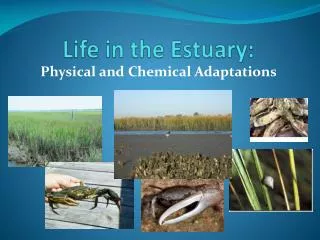
Life in the Estuary: Physical and Chemical Adaptations
Physical and Chemical Features of the Estuary Physical Chemical • Tidal flow/current • Storms/wave action/erosion • Staying put • Temperature • Extremes • Desiccation • Not freezing • Salinity • Tidal influence • Rainfall • Drought • Snow melt • Organism internal maintenance • Osmosis
Osmosis: Diffusion of a liquid (water) through a semipermeable membrane (gill, skin, etc) from and area of relatively lower osmotic concentration to an area of relatively higher osmotic concentration in an attempt to equalize both concentrations Fundamentals For example: Fish have internal osmotic concentration Approx 1/3 of seawater. As a result, freshwater fish are constantly urinating and saltwater fish are constantly drinking.
Factors that Influence Changes Physical Chemical • Moon phase • Alters tidal amplitude (speed) • Weather • Storms may cause severe wave action • Rainfall • May increase (or decrease) currents • Snowmelt • Spring melts often increase flow • Global Warming • Sea level rise may result in different current patterns • Moon Phase • Tidal amplitude may increase (or decrease) distance of salt wedge intrusion • Weather • Storms may alter mixing • Rainfall • Dilution of salinity • Snowmelt • Dilution of salinity • Global Warming • Some species have temperature dependent sex determination (Sea Turtles)
Physical Adaptation Temperature Salinity/Exposure Flow • Move • Swim (i.e. fish) • Fly (i.e. birds) • Burrow (i.e. crabs) • “Clam up” • (i.e. clams/oysters) • Dormancy • Plants • Move • Swim (i.e. fish) • Fly (i.e. birds) • Burrow (i.e. crabs) • “Clam up” • (i.e. clams/oysters) • Excretion • Grasses • Go with current • Fish eggs • Plankton • Algae • Crabs • Sessile • Attach using natural cement • Oysters/barnacles • Attach with large and/or intricate roots • Kelps and grasses • Epiphytes
Chemical Adaptation Temperature Salinity • Dormancy • Plants • Antifreeze? • fish • Osmosis • Constant battle against the forces of diffusion