Technical Overview: Provisional T-Stenting with the Frontier Stent in Coronary Bifurcation Cases
70 likes | 202 Vues
This technical overview details the procedural considerations for provisional T-stenting using the Guidant Frontier Stent in coronary bifurcation lesions. Highlighting critical steps such as lesion selection, lesion preparation, and technical issues encountered during stent deployment, this guide emphasizes optimal practices to preserve side branch access and ensures effective stent positioning. Key factors, including wire management and balloon inflation techniques, are discussed to aid interventional cardiologists in improving their procedural outcomes.


Technical Overview: Provisional T-Stenting with the Frontier Stent in Coronary Bifurcation Cases
E N D
Presentation Transcript
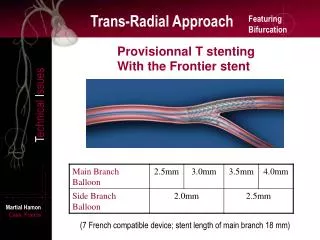
Provisionnal T stenting With the Frontier stent Technical Issues GUIDANT Martial Hamon Caen, France (7 French compatible device; stent length of main branch 18 mm)
Diago. Wiring 2 vessels LAD Case After Kissing Balloon dilation Placement of The Frontier stent Procedure
Frontier implantation Provisionnal T stenting Direct stenting of side branch Simutaneous kissing procedure Final Result Case Procedure
Provisionnal T stenting With the Frontier stent Case Procedure Before After
Guidant MUTI-LINK FRONTIER™ Coronary Bifurcation Stent System • Designed for preserving side branch access • Integrated-tip design allows single tip delivery, avoiding wire wrap • Stent deploys with simultaneous “kissing balloon inflation” • Wire position is maintained in both branches throughout the procedure Stent Description
Lesion selection and preparation • Lesion type: to be avoided • calcified vessels • Tortuous vessels • very small vessels. • Preparation of lesion • Pre-dilate the lesion(s) • Keep 2 wires in place after pre-dilatation, to facilitate your exchange wire placement through the OTW lumen (buddy wire technique). Technical Issues • Materials • ≥ 7 French guiding catheter recommended • Long guide wire for side branch access (extra-support preferred) • The nominal diameter is the distal diameter of the device. The proximal diameter is 0.6 to 0.8 mm larger.
Manipulation • Do not torque the system. It is NOT designed to respond to torque • Remove the mandrel when the integrated tip is near the carina • Once mandrel is removed, do not push the system forward without a second guide wire in the OTW lumen emerging distally. • Use the middle balloon marker for good placement of the Frontier stent at the carina. • Observe the relative position of the two guide wires, as parallel wires with clear divergence at the carina indicate optimal positioning prior to deployment. • Do not pull back un-deployed Frontier system through guiding catheter. If needed, pull back entire system with the guiding catheter as a single unit. • Post-dilate with kissing balloons if result is not optimal following Frontier deployment. Technical Issues