Understanding Indoor Air Pollutants: Types, Sizes, and Impacts on Health
This guide explores the various indoor air pollutants, their typical sizes measured in microns, and their prevalence in indoor environments. It highlights how particles like dust, pollen, bacteria, and viruses can be suspended in the air, affecting our health. With insights into how these pollutants linger in the breathing zone and the duration of their suspension, the importance of air filtration systems, such as HEPA filters, is emphasized for effective odor and contaminant removal. Learn more about maintaining healthier indoor air quality!

Understanding Indoor Air Pollutants: Types, Sizes, and Impacts on Health
E N D
Presentation Transcript
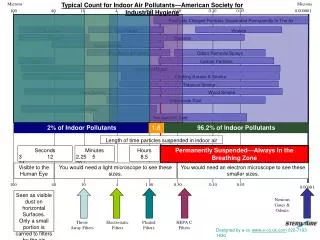
Microns Typical Count for Indoor Air Pollutants—American Society for Industrial Hygiene Microns 100 40 10 4 1.00 0.30 0.10 0.05 0.000001 Positively Charged Particles Suspended Permanently In The Air Sneezes Skin Flakes Viruses Pollen Bacteria Animal Dander Dust Mites & Faeces Odour Removal Sprays Hair Carbon Particles Household Dusts Cooking Grease & Smoke Lint Tobacco Smoke Plant Spores Wood Smoke Insecticide Dust Soil Dust Atmospheric Dust 2% of Indoor Pollutants 1.8% 96.2% of Indoor Pollutants Length of time particles suspended in indoor air Permanently Suspended—Always In the Breathing Zone includes 98% of germs that cause diseases Seconds 3 12 34 Minutes 2.25 5 20 Hours 8.5 Visible to the Human Eye You would need a light microscope to see these sizes. You would need an electron microscope to see these smaller sizes. 40 10 4 1.00 0.30 0.10 0.05 100 0.00001 Seen as visible dust on horizontal Surfaces. Only a small portion is carried to filters by the air stream. Noxious Gases & Odours Throw Away Filters Electrostatic Filters Pleated Filters HEPA C Filters Designed by e-co www.e-co.uk.com 020-7193-1630