Analyzing Inferences and Implications in "The Killing Joke"
This activity explores the inferences and implications drawn from the graphic novel "The Killing Joke." Readers will analyze information that is suggested by the author but not explicitly stated. Through guided sentence frames, participants will contemplate what they can infer about the characters, particularly the Joker, and the author's intent. Discussion questions will encourage deeper understanding of narrative techniques, such as point of view and the balance between showing and telling in storytelling. Engaging with the text critically develops analytical skills in literary interpretation.

Analyzing Inferences and Implications in "The Killing Joke"
E N D
Presentation Transcript
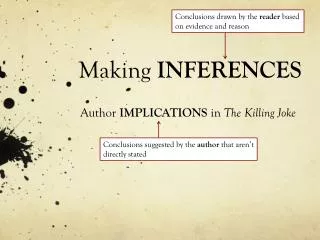
Conclusions drawn by the reader based on evidence and reason Making INFERENCES Conclusions suggested by the author that aren’t directly stated Author IMPLICATIONS in The Killing Joke
Framing your answers for this activity SENTENCE FRAMES • I can infer that _____________________. • The author implies that ______________. • My inference is that _________________. • The author’s implication is that ________.
Wait a minute. The Joker gets his white skin by falling into a vat of water?!
If something doesn’t make sense, go back and check the evidence.
Consider this evidence: What is the main implication? (write answer down individually)
What is the main implication? (write answer down individually)
Discussion Questions: • Why does the author imply so much information? In other words, why doesn’t the author just illustrate and create dialogue telling the reader that the Joker in jail is a fake? • Is it fair to expect the reader to infer so much from the story? Is it fair in “The Killing Joke”? Is it fair in “Hills Like White Elephants”? • What is the Point-of-View in “The Killing Joke”? Is it possible to tell a story in the graphic novel format from any of the other points-of-view(1st-person, 3rd-person limited, or 3rd-person omniscient)? How might the author have done this?