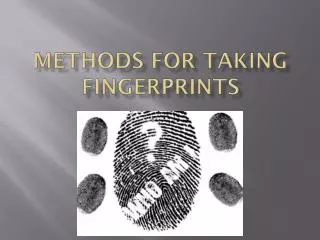
Methods for Taking Fingerprints
130 likes | 255 Vues
This guide explores various methods for taking and developing fingerprints, including visible, plastic, and latent prints. It details techniques for developing latent prints on both porous and non-porous surfaces using tools such as RUVIS, powder, super glue fuming, iodine fuming, and ninhydrin. The transport and classification of prints are also covered, emphasizing the importance of proper handling and comparison with digital databases. Enhance your forensic knowledge and skills with these essential fingerprinting techniques.


Methods for Taking Fingerprints
E N D
Presentation Transcript
Visible Prints • Visible prints are made when fingers touch a surface after toughing a colored substance like blood, ink, grease, paint, ect. • Plastic Prints • Are made when ridge impressions are left in soft surfaces like putty, wax, soap, dust, ect.
Latent Prints • On hard and non-absorbent surfaces • Ex. tile, mirrors, painted wood • Developed with powder • On Porous surfaces • Ex. Papers cardboard, and cloth • Devolved using chemicals
Latent print developing techniques • RUVIS • Reflected Ultraviolet Imaging System • Used to locate latent prints • Powder • Used once prints are located • Comes in several colors, magnetic and non magnetic • Adheres to perspiration and oils in print • Can be photographed or collected with tape
Latent print developing techniques • Super Glue fuming • Used on nonporous surfaces • Ex metals, electrical tape, leather and plastic • Fumes of super glue adhere to proteins in print and make a white visible print • Made of 99% cyanoacrylate ester, which is what makes the prints visible • Can be done in a fuming chamber or with a handheld wand • Iodine Fuming • Iodine crystals are heated and fumes combine with print to make them visible • Not permanent, will fade quickly
Latent print developing technique • Ninhydrin • Reacts with amino acids in prints to make a purple blue color • Physical Developer • Is a silver nitrate based reagent • Used when other techniques fail • Other chemicals used include those that cause the print to fluoresce under a laser or high intensity light source such as… • Quartz halogen, xenon arc, indium arc
Transporting prints • Small Objects • Transport entire object • Large objects • Photograph first • Allows print to be compared to digital database • Then lift with tape and place on labeled cards
One more identification technique Loop Count Loop Count = 8