Course business
Explore the intricate world of chivalric romance through "Sir Gawain and the Green Knight." This course dives into the themes of courtly love, knightly ideals, and the narrative structures that defined medieval literature. Analyze Chrétien de Troyes' influence and the concept of the noble lady, and engage with the text's metrical forms, including the Alliterative Revival. Gain insights into the moral dilemmas faced by Gawain and the broader implications of loyalty, bravery, and honor in the realm of feudal society. Join us to unravel these timeless themes!

Course business
E N D
Presentation Transcript
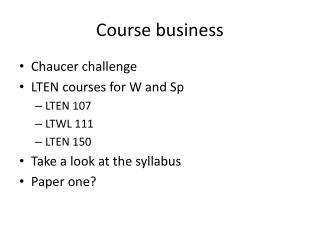
Course business • Chaucer challenge • LTEN courses for W and Sp • LTEN 107 • LTWL 111 • LTEN 150 • Take a look at the syllabus • Paper one?
Sir Gawain and the Green Knight • Romance—Chivalric Romance • Chrétien de Troyes • Knightly Character—Auerbach • Courtly Love • Metrical Romance • Alliterative Revival
Romance • Terms from Murfin and Ray • Romance is a genre • 12th c. narrative form • Chrétien de Troyes • Line 1509 ff
Erich Auerbach on Romance • “A self-portrayal of feudal knighthood with its mores and ideals is the fundamental purpose of the courtly romance”
Courtly Love • Troubadors • Court of Eleanor of Aquitaine • Chrétien de Troyes • Arabic Influences • Courtly context • Poetic forms: lyric, romance, allegory
Some characteristics of “Courtly Love” • Elevated status of the “lady” • Terminology of feudalism • Secrecy/adultery • Love as ennobling (neoplatonism) • Love is rooted in the soul • Love is faithful • Role of sexuality
Form--SGGK • Metrical Form and the Alliterative Revival • Alliterative Stanza • Bob • Wheel • Tight Narrative Structure
SIÞEN þe sege and þe assaut watz sesed at Troye, Þe borȝ brittened and brent to brondeȝ and askez, Þe tulk þat þe trammes of tresoun þer wroȝt Watz tried for his tricherie, þe trewest on erthe: Hit watz Ennias þe athel, and his highe kynde, Þat siþen depreced prouinces, and patrounes bicome Welneȝe of al þe wele in þe west iles. Fro riche Romulus to Rome ricchis hym swyþe, With gret bobbaunce þat burȝe he biges vpon fyrst, And neuenes hit his aune nome, as hit now hat; Tirius to Tuskan and teldes bigynnes, Langaberde in Lumbardie lyftes vp homes, And fer ouer þe French flod Felix Brutus On mony bonkkes ful brode Bretayn he settez wyth wynne, Where werre and wrake and wonder Bi syþez hatz wont þerinne, And oft boþe blysse and blunder Ful skete hatz skyfted synne.
Narrative Structure • Parallels • Numerical Patterns
Cotton Nero A.x. • The Pearl Poet • Patience • Cleanness • Pearl
Fit One • Camelot and Troy • Opening—is everything what it seems? • The Christmas Feast • A kissing game (Line 17)
Camelot and Troy • Noble history (Aeneas, Brutus) • Troubled history • The demise of Camelot
The Christmas Feast • There’s something about Arthur • Line 85 • But Arthur would not eat until all were served • The Green Knight’s Challenge • Line 224 ff
The Green Knight • “AghlichMayster” • Trans. line 136 “unknown rider” or “a fearful form”
Fit Two--Overview • The Seasons • The Pentangle Shield • Wilderness vs. Civilization
Pentangle Shield (l. 618 ff) • God’s armor : Ephesians 6 • Interlocking virtues • The Number 5 • Solomon • Connected to Girdle
Fit II • Wilderness and Civilization • Line 691 ff
Fit II Some Parallelisms • Another Court • The Two Ladies (Line 950 ff.) • Another Christmas Game (l. 1105 ff.)
Fit III--Overview • The Two Hunts • The Agreement with Bercilak • Questioning the text: Why all these detailed hunting scenes?