Understanding Red-Black Trees: Properties, Insertion, and Deletion Algorithms
Red-Black Trees are a specific type of self-balancing binary search tree that maintains efficient time complexity for operations like searching, insertion, and deletion. This structure uses nodes colored red or black to ensure properties that regulate tree height, resulting in O(log n) performance. Key properties include the root being black, leaves as black, and children of red nodes as black. Insertion and deletion involve complex cases of restructuring and recoloring to maintain balance. Mastering these concepts is crucial for optimizing software that relies on dynamic data sets.

Understanding Red-Black Trees: Properties, Insertion, and Deletion Algorithms
E N D
Presentation Transcript
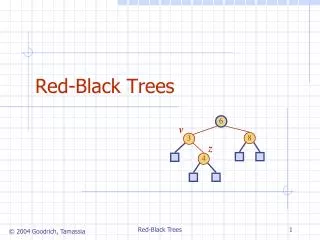
Red-Black Trees 6 v 8 3 z 4 Red-Black Trees
A red-black tree is a representation of a (2,4) tree by means of a binary tree whose nodes are colored red or black In comparison with its associated (2,4) tree, a red-black tree has same logarithmic time performance simpler implementation with a single node type 4 2 6 7 3 5 4 From (2,4) to Red-Black Trees 5 3 6 OR 3 5 2 7 Red-Black Trees
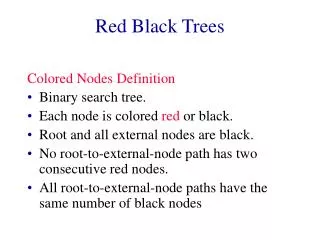
Red-Black Trees • A red-black tree can also be defined as a binary search tree that satisfies the following properties: • Root Property: the root is black • External Property: every leaf is black • Internal Property: the children of a red node are black • Depth Property: all the leaves have the same black depth 9 4 15 21 2 6 12 7 Red-Black Trees
Height of a Red-Black Tree • Theorem: A red-black tree storing nentries has height O(log n) Proof: • The height of a red-black tree is at most twice the height of its associated (2,4) tree, which is O(log n) • The search algorithm for a binary search tree is the same as that for a binary search tree • By the above theorem, searching in a red-black tree takes O(log n) time Red-Black Trees
To perform operation put(k, o), we execute the insertion algorithm for binary search trees and color red the newly inserted node z unless it is the root We preserve the root, external, and depth properties If the parent v of z is black, we also preserve the internal property and we are done Else (v is red ) we have a double red (i.e., a violation of the internal property), which requires a reorganization of the tree Example where the insertion of 4 causes a double red: Insertion 6 6 v v 8 8 3 3 z z 4 Red-Black Trees
Remedying a Double Red • Consider a double red with child z and parent v, and let w be the sibling of v Case 1: w is black • The double red is an incorrect replacement of a 4-node • Restructuring: we change the 4-node replacement Case 2: w is red • The double red corresponds to an overflow • Recoloring: we perform the equivalent of a split 4 4 w v v w 7 7 2 2 z z 6 6 4 6 7 2 4 6 7 .. 2 .. Red-Black Trees
Restructuring • A restructuring remedies a child-parent double red when the parent red node has a black sibling • It is equivalent to restoring the correct replacement of a 4-node • The internal property is restored and the other properties are preserved z 6 4 v v w 7 7 2 4 z w 2 6 4 6 7 4 6 7 .. 2 .. .. 2 .. Red-Black Trees
6 2 6 4 4 2 2 6 4 Restructuring (cont.) • There are four restructuring configurations depending on whether the double red nodes are left or right children 2 6 4 4 2 6 Red-Black Trees
Recoloring • A recoloring remedies a child-parent double red when the parent red node has a red sibling • The parent v and its sibling w become black and the grandparent u becomes red, unless it is the root • It is equivalent to performing a split on a 5-node • The double red violation may propagate to the grandparent u 4 4 v v w w 7 7 2 2 z z 6 6 … 4 … 2 4 6 7 2 6 7 Red-Black Trees
Analysis of Insertion Algorithmput(k, o) 1. We search for key k to locate the insertion node z 2. We add the new entry (k, o) at node z and color z red 3. whiledoubleRed(z) if isBlack(sibling(parent(z))) z restructure(z) return else {sibling(parent(z) is red } z recolor(z) • Recall that a red-black tree has O(log n) height • Step 1 takes O(log n) time because we visit O(log n) nodes • Step 2 takes O(1) time • Step 3 takes O(log n) time because we perform • O(log n) recolorings, each taking O(1) time, and • at most one restructuring taking O(1) time • Thus, an insertion in a red-black tree takes O(log n) time Red-Black Trees
Deletion • To perform operation remove(k), we first execute the deletion algorithm for binary search trees • Let v be the internal node removed, w the external node removed, and r the sibling of w • If either v of r was red, we color r black and we are done • Else (v and r were both black) we color rdouble black, which is a violation of the internal property requiring a reorganization of the tree • Example where the deletion of 8 causes a double black: 6 6 v r 8 3 3 r w 4 4 Red-Black Trees
Remedying a Double Black • The algorithm for remedying a double black node w with sibling y considers three cases Case 1: y is black and has a red child • We perform a restructuring, equivalent to a transfer , and we are done Case 2: y is black and its children are both black • We perform a recoloring, equivalent to a fusion, which may propagate up the double black violation Case 3: y is red • We perform an adjustment, equivalent to choosing a different representation of a 3-node, after which either Case 1 or Case 2 applies • Deletion in a red-black tree takes O(log n) time Red-Black Trees
Red-Black Tree Reorganization Red-Black Trees