This Day in History
On April 4, 1818, the United States adopted a flag as a national symbol, evolving from an original design with 13 stripes and 20 stars. Previously, on September 25, 1789, the first ten amendments, known as the Bill of Rights, were proposed by James Madison, aiming to safeguard individual rights and liberties in American law and governance. Understanding key legal concepts such as petition, militia, probable cause, and due process is essential for grasping the framework of rights protected by these foundational documents.

This Day in History
E N D
Presentation Transcript
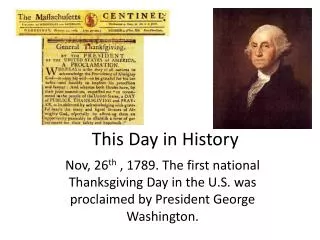
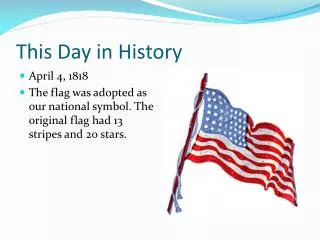
This Day in History • April 4, 1818 • The flag was adopted as our national symbol. The original flag had 13 stripes and 20 stars.
The Bill of Rights Mr. Kraemer
Review • September 25, 1789 • First ten amendments to the constitution • Proposed by James Madison • Meant to be a guide to the rights of all people • Used in American law and government
Petition: a formal written request made to an official person or organized body Militia: a part of the organized armed forces of a country liable to call only in emergency Quartered: to provide with lodging or shelter Probable Cause: a reasonable ground for supposing that a charge is well-founded Affirmation: a solemn declaration made under the penalties of perjury by a person who conscientiously declines taking an oath Indictment: a formal written statement framed by a prosecuting authority and found by a jury charging a person with an offense Due process: the rule that a legal case must be done in a way that protects the rights of all the people involved Impartial: not partial or biased : treating or affecting all equally
Ascertained: to find out or learn with certainty Compulsory: Mandatory; enforced Imposed: to establish or apply by authority Enumeration: to specify one after another Construed: to understand or explain the sense or intention of usually in a particular way or with respect to a given set of circumstance Disparage: to degrade Delegated: to entrust to another
In Class Assignment • Teacher will assign partners • When given a number(s) for a certain amendment reread that amendment • Next, put the amendment into your own words (will be written on the board) • Last, create a short scenario, or skit in which to portray the amendment