Understanding Categorical Logic: Concepts, Claims, and Real-World Applications
Categorical logic serves as a crucial tool for characterizing relationships in various fields, including law, business contracts, and both natural and social sciences. It revolves around categorical claims which can be expressed in natural language as "All X are Y," "No X are Y," and "Some X are Y." This logic utilizes the Square of Opposition to illustrate the relationships among these claims. Understanding these principles enhances our ability to reason accurately and make informed decisions in complex scenarios.

Understanding Categorical Logic: Concepts, Claims, and Real-World Applications
E N D
Presentation Transcript
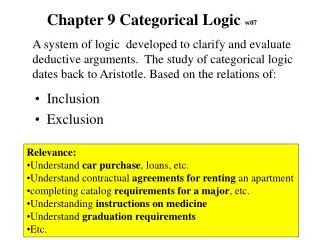
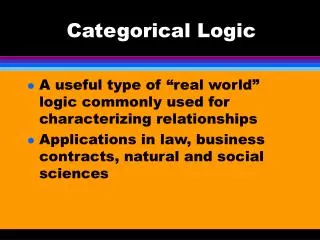
Categorical Logic • A useful type of “real world” logic commonly used for characterizing relationships • Applications in law, business contracts, natural and social sciences
Categorical Claims • A: All X are Y
Categorical Claims • A: All X are Y In natural language: Every X is a Y. Each X is a Y. If it is an X, then it is a Y. All Xs are Ys. Any X is a Y. All non-Ys are non-Xs. Only Ys are Xs The only Xs are Ys
Categorical Claims • A: All X are Y In natural language: Every X is a Y. Each X is a Y. If it is an X, then it is a Y. All Xs are Ys. Any X is a Y. All non-Ys are non-Xs. Only Ys are Xs The only Xs are Ys Note: X and Y must be nouns or noun phrases.
Categorical Claims • A: All X are Y • E: No X are Y
Categorical Claims • A: All X are Y • E: No X are Y • I: Some X are Y
Categorical Claims • A: All X are Y • E: No X are Y • I: Some X are Y Note: The range of “some” in categorical logic is from as few as one to as many as all of the things in the category.
Categorical Claims • A: All X are Y • E: No X are Y • I: Some X are Y • O: Some X are not Y
A-claim E-claim I-claim O-claim The Square of Opposition Claims of different types with the same subject and predicate terms are corresponding claims.