Understanding Prokaryotic and Eukaryotic Cells: Structure, Functions, and Division
This overview explores the fundamental differences between prokaryotic and eukaryotic cells. Prokaryotes, such as bacteria, lack a nucleus and are unicellular. In contrast, eukaryotic cells possess a nucleus and complex organelles, forming either unicellular or multicellular organisms like humans. The text delves into cellular energy production, emphasizing the roles of mitochondria and chloroplasts, and outlines the processes of mitosis and meiosis, detailing cell division, growth, and the creation of gametes. Key elements such as diffusion, osmosis, and cell cycle phases are also summarized.

Understanding Prokaryotic and Eukaryotic Cells: Structure, Functions, and Division
E N D
Presentation Transcript
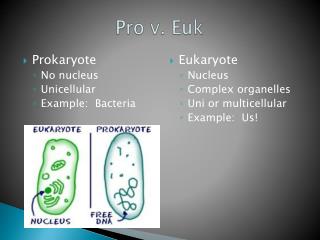
Prokaryote No nucleus Unicellular Example: Bacteria Eukaryote Nucleus Complex organelles Uni or multicellular Example: Us! Pro v. Euk
Cell Energy • Responsible organelles • Animal cell – mitochondria • Plant cell – chloroplast • It’s all about ATP • Make it or break it
Cell membrane – controls what goes in and out ER – tubes for transport Lysosome – digestive enzymes Vacuole – temp. storage Mitochondria – energy! Golgi – repackage stuff Cytoplasm - fluid Organelles
Cell Cycle • Growth and division of cells • IPMAT • Interphase – 80% of the time – DNA copies • Prophase • Metaphase • Anaphase • Telophase
Mitosis • Process of cell division resulting in two identical cells (daughter cells) that are the same as the parent cell. Body cells are made.
Meiosis • Process of cell division in which four "daughter" cells are produced from one "parent" cell, each with half of the genes of the parent. Makes gametes or sex cells.
Meiosis • Mitosis – somatic cells • Meiosis – makes sex cells (sperm & egg) • AKA gametes • Have a half-set of chromosomes (haploid) • 2 cell divisions • Makes 4 cells • Same phases IPMATPMAT
Mitosis 1 cell division Daughter cells identical to parents cells Produces 2 cells 2n → 2n Produces cells for growth and repair No crossing over Meiosis 2 cell divisions Daughter cells different from parents Produces 4 cells 2n → 1n Produces gametes Crossing over Mitosis v. Meiosis
Diffusion & Osmosis • The movement of particles from high to low concentration • Osmosis = water only • Cell membrane responsible • Semi-permeable • Want to achieve homeostasis