Understanding Human Perception: Insights from Virtual Reality and Community Medicine
This lecture outline explores the intricate nature of human perception through the lens of virtual reality and community medicine. Key topics include differentiating between sensation and perception, recognizing features and organizational aspects of perception, and understanding depth perception cues. The session also addresses the importance of hypothesis testing and its relevance in medical contexts. By examining perceptual development and the interplay of sensory inputs, we aim to enhance diagnostic skills and improve patient interactions within healthcare settings.

Understanding Human Perception: Insights from Virtual Reality and Community Medicine
E N D
Presentation Transcript
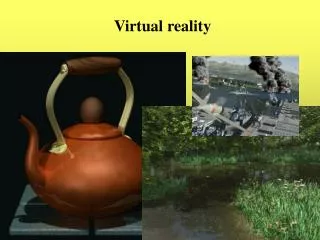
A virtual reality? Human perceptual function R.Fielding Community Medicine & BSU HKU
Lecture outline • Learning objectives • Sensation versus perception • Features of perception • Stimulus characteristics • organizational aspects • Hypothesis testing • Depth perception & cues • Perceptual development
Learning objectives • differentiate between sensation and perception. • describe key functional features of human perceptual system. • list stimulus characteristics commanding attention and describe organizational aspects of stimulus processing.
define and give reasons for importance of illusions and hypotheses-testing features of perception. • give examples of visual cues in depth perception. • Describe the main stages of perceptual development.
Sensation vs. perception • Sensation • Sense organs are energy detectors and signalling devices, which give rise to • afferent neural activity. • afferent activity presents centrally primarily as sensation.
Perceptions : • are synthetic central processes involving the attribution of meaning to extrinsic and intrinsic activity. • are rule bound hypotheses applied to anticipated stimuli. • have “bottom-up” and “top-down” features.
Functional features • Recognition • Attentional processes • Limited capacity channels • Bottom-up processing (input driven e.g. detection of specific elements and assembly into complex forms e.g. geons*).
Top-down processing (knowledge driven, e.g. contexts and expectations) • Constancies • Synthesis • Top-down processing • Hypothesis-testing
Stimulus characteristics • Size, colour, shape, location, pitch, timbre. • intensity (brightness/volume) • magnitude (size) • contrast • novelty • salience (relevance)
Organizational aspects • Stimuli are provisionally organized (pre-attentively) according to bottom-up processes • feature analysis; proximity; organization; similarity; simplicity; continuity.
Hypothesis testing • Figure-ground • perceptual patterning • illusions These illustrate the dynamic nature of perception - i.e. perception is not just passive reception of sensation but an active process of constructed experience based on hypotheses
Depth perception and cues • Monocular cues • interposition; relative size; height in plane; linear perspective; texture gradient; light and shadow. • Binocular cues • parallax; ocular convergence
Perceptual development • Is perception innate or learned? • Birth: visual acuity low: vision directed at contrast boundaries. • by 3/12 facial expression detectable. • by 6/12 acuity good, 1-5 years =adult. • ~6/12 constancies and self/non-self • Critical periods for visual development
Perceptual-motor (p-m) coordination intimately linked to stimulation and active interaction with environment. • New p-m learning rapid even in adulthood if self-generated activity allowed, but not if inactive.
Relevance to medical care • Perceptions of threat, vulnerability, risk • Perceptions of patients by doctors and or doctors by patients • Preparation for medical procedures • Pain and pain control, neurological topics • Diagnostic skill and error • Paediatrics, geriatrics, intensive care • Examinations • and every other aspect of medical practice...
Further information • Atkinson RL, et al. (1993) Introduction to Psychology (11th Edn.) Ch.5, p. 164-201. or • Weiten W. (1992) Psychology: Themes and variations. Ch 4. 107-151. • Weinman J. (1997) An outline of psychology as applied to medicine. Ch 2. • Http://www.bhs.mq.edu.au/psy/105/lectures • Lectures on Feature Detector and visual illusions & constancies.