Understanding Subject-Verb Agreement: Key Rules and Examples
This guide provides a clear overview of subject-verb agreement rules essential for correct sentence construction. It covers the fundamentals, such as using singular verbs with singular subjects and plural verbs with plural subjects. Discover how to handle subjects joined by "and" or "or," ensuring your verbs align accurately with your subjects. With practical examples like "The girls eat" versus "The girl eats" and situations involving compound subjects, you'll grasp the nuances of agreement in English grammar, enhancing your writing clarity and effectiveness.

Understanding Subject-Verb Agreement: Key Rules and Examples
E N D
Presentation Transcript
Subject-Verb agreement By: Shaysse, Ingrit, Isabella, Byanka
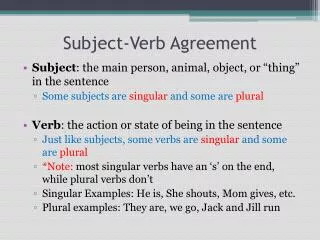
Rule 1 • Singular subjects need a singular verb • Plural Subjects need plural verb • Plural subjects usually end in “s”. (Boys, Cats) • Singular verbs usually end in “s”. (Runs, Sings) The girls eat. (Plural) The girl eats. (Singular)
Rule 2 • When the subject of a sentence has two or more nouns connected by ‘and’ use a plural verb. Example; • George and John own the car. • Maria and Daniella play outside.
Rule 3 • When two or more singular nouns are connected by ‘or’ or ‘nor’ use a singular verb. • Example; Sam or Jessica eats the pizza. Jim nor Carlos drives their mothers car.
Rule 4 • When a subject contains both a singular and a plural noun joined by ‘or’ or ‘nor’ the verb should agree with the subject that is closer to the verb. Examples: The Dogs and Cat eats their food. The Penguin and Pigs play with their owner.