Summary Dramatic Methods in Top Girls
Summary Dramatic Methods in Top Girls. Dramatic methods. Dramatic Language Dramatic Staging Dramatic Structure (see previous lect.). (a) Dramatic Language. The language of drama is a language that is performable (i.e. acted out before an audience)

Summary Dramatic Methods in Top Girls
E N D
Presentation Transcript
Dramatic methods • Dramatic Language • Dramatic Staging • Dramatic Structure (see previous lect.)
(a) Dramatic Language • The language of drama is a language that is performable (i.e. acted out before an audience) • Gestures, actions, use of props, social grouping and emotional states are implicitly present in dramatic language. • Different from non-dramatic poetry or prose
Dramatic Language • Language use • Tone & attitude of women towards one another in establishing relations of power & solidarity • Overlapping dialogue • Different speech codes / registers to characterize class differences • Male/female styles of speech • Pronouns (‘Us’ vs. ‘Them’) • Naming – labels, terms of address • Expletives • Silences
Subtext - draws on the cultural knowledge and assumptions shared by the audience for the purpose of demystifying them • Allusions (esp. in Act 1) • Irony • Humour – comic balances the tragic
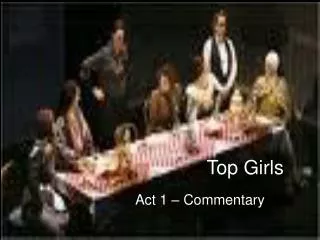
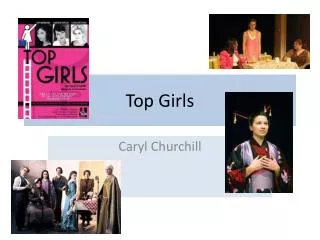
(b) Dramatic Staging • All female cast • Staged settings • Staged actions (e.g. movement, laughing & crying) • Costuming • Use of visual ‘absences’ (e.g. no physical presence of men, Marlene never seen in her own home)
Brechtian technique of alienation - a defamiliarizing process in which the audience is constantly made aware that they are watching a play the constructed-ness of role-playing - E.g. casting adults to play the roles of Angie & Kit; surreal act of conjuring dead women from the past • Doubling
Symbolic significance of visual props & gestures: • Dressing (e.g. Angie’s dress in Act 2 & 3) • Drinking (e.g. wine, whiskey) • Tables (e.g. restaurant table set for dinner in Act 1, three desks in Act 2 Sc 3, kitchen table without dinner in Act 3)
Distinctiveness of Churchill? • As feminist playwright • Concerned with woman’s struggle for autonomy in an unjust society • Consciousness-raising of sexual stereotypes & gender discrimination against women • But TG is a feminist play that is self-critical of the women’s movement • Critiques one style of feminism (bourgeois feminism) & contrasts it with another (socialist feminism)
Experiments with dramatic form & structure • Breaks away from the structure & conventions of realism • Juxtaposition of the real & surreal (esp. in conjuring women role models from history & literature in Act 1); fragmented time & backward progression • All female cast with the reversal of sex roles to expose and satirise gender stereotyping • Overlapping dialogue – the ‘naturalness’ of speech that is constructed • Doubling
Dramatic effects • Imagine the scene – how would the audience respond & by what dramatic methods? • Feelings evoked? - climatic or anti-climatic, distant or involved, empathetic or dispassionate • How does the scene develop our attitudes towards a particular character / situation / thematic issue in relation to the play as a whole?