Download
1 / 18
190 likes | 330 Vues
This presentation by Tashi Parsons-Moss at BNL NCSS 2006 delves into the complexities of neutrinoless double beta decay (0νββ) and its significance in understanding neutrino mass and the fundamental workings of the weak interaction. It covers the history of neutrinos, the proposed mechanisms for 0νββ decay, recent experimental results, and the challenges faced in detection, including issues related to nuclear matrix elements and background noise. Special focus is given to promising experimental setups, such as GENIUS and MOON, and their roles in the ongoing search for this elusive process.

E N D
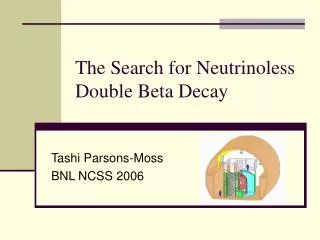
The Search for Neutrinoless Double Beta Decay Tashi Parsons-Moss BNL NCSS 2006
β Decay and Weak Interaction • (A, Z) (A, Z + 1) + β-+ e (1) • (A, Z) (A, Z - 1) + β++ e (2) • (A, Z) + e- (A, Z - 1) + e (3)
Neutrinos • e , µ , • 1930 – postulated by Pauli • 1956 – detected by Cowen et al. • Oscillations and Mass
Double Beta Decay • (A, Z) → (A, Z + 2) + 2e- + 2 (48Ca, 76Ge, 82Se, 96Zr, 100Mo, 116Cd, 128Te, 130Te, 150Nd, 238U) • (A, Z) → (A, Z + 2) + 2e- • (A, Z) → (A, Z + 2) + 2e- + 0(+0)
Possible Mechanisms of 0ββ decay • SUSY particles • Leptoquarks • Right-Handed weak interaction • Light of Heavy Majorana Neutrinos
0ββ Decay and Neutrino Mass • 3 Ranges of Mass sensitivity: • Quasi-Degenerate ~100-500 meV • Atmospheric neutrino oscillation results ~20-55 meV • Solar neutrino oscillation results ~2-5 meV
What’s the big deal? • = ? • Absolute mass scale for neutrinos • Leptogenesis • Weak Force • Grand Unified Theories
Challenges • Determining the dominant mechanism • Uncertainties in nuclear matrix elements • Limited resources, expense • Background, background, Background!!! • 2ββ peak • Cosmic radiation • Intrinsic background • Shielding and cryostat material
Heidelberg-Moscow • 71.7 Kg-y data • Controversial Results • Increased interest in quasi-degenerate 76Ge experiments
GENIUS (Germanium Nitrogen Underground Setup) • Assumes limiting background on HM from external sources • Array of 2.5 Kg p-type 86% enriched Ge crystals “naked” in LN2
Majorana • Assumes 68Ge within Ge detectors was limiting background in IGEX • 210 86% enriched, segmented n-type Ge crystals in ultra-pure electroformed Cu cryostats
MOON (Mo Observatory of Neutrinos) • Uses unique nuclear structure of 100Mo to combine 0ββ search and solar neutrino experiment • Modules of plastic fiber scintillators with thin layers Mo
Acknowledgements I would like to thank Richard Ferrieri and all of the TA’s, professors, students and supporters of the BNL Nuclear and Radiochemistry Summer School