Comprehensive XML Data Management Course: Structure, Techniques, and Practical Applications
This course provides an in-depth understanding of XML data management, covering the XML data model, usage of XML technologies, and hands-on experience with tools for generating, parsing, processing, and storing XML. Students will learn to specify XML document structures using DTDs and XML Schema, query and transform XML documents with XPath, XSLT, and XQuery, and build applications that handle XML data. The course includes lectures, lab sessions, and coursework that support practical skills and theoretical knowledge in XML management.

Comprehensive XML Data Management Course: Structure, Techniques, and Practical Applications
E N D
Presentation Transcript
XML Data Management Course Outline and Organisation Werner Nutt
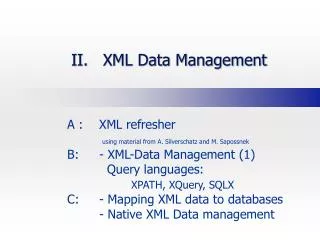
Objectives • Overview of • XML data model, • usage of XML • technologies to handle XML (generate, parse, process, store) • Present Languages to specify the structure of XML documents (DTDs and XML Schema) • Present Languages to query and transform XML documents (XPath, XSLT, XQuery) • Introduce Tools that implement these languages (parsers, editors, validity checkers, query engines, etc.)
Students will … • try out the tools in the labs • solve exercises • write DTDs and XML schemas • query documents with XPath • transform documents with XSLT and XQuery • build small applications that process XML data, e.g., • find differences between documents • write a Web application using XQuery (Coursework!)
Course Content (1) • Purpose and usage of XML • XML Syntax: • XML markup rules • well-formed XML documents • Specifying the structure of documents: DTDs • More expressive schemas: XML schema • Extracting data from documents: XPath • Querying and constructing XML with XQuery • Transforming documents with XSLT
Course Content (2) • Parsing and generating XML with a programming language: • DOM and SAX parsing in Java Possibly: • XML and relational databases: • PostgreSQL support for XML • Native XML databases • BaseX, eXist
Student Input I have given the course already last year, but • I would like to try out new things the course is not yet 100% prepared. If you have ideas, proposals for further • topics • activities, let me know. I will see whether we can accommodate them.
Course Format • Lectures • introduce new concepts, give examples • Labs • exercises (preparation for exam questions) • support for projects • Coursework projects • Handling XML in Java: define and develop your version of xdiff • Web application in XQuery (?)
Books Textbooks • Learning XML, 2nd Edition By Erik T. Ray • XQuery, By Priscilla Walmsley Both books are available as electronic editions at the library website (need login and passwd) Additional reading: • Einstieg in XML: Grundlagen, Praxis, Referenz, By Helmut Vonhoegen Hardcover book, available in the library
Course Organization • Lectures: Wed 10:30-12:30 (room changes!) • Labs: Mo 16:00-17:00, SER-E 431 • Office hours: Mo 15:00-16:00, POS 2.09 • Course web site will develop at www.inf.unibz.it/~nutt/XMLDM1213 Will contain • slides • lab instructions • example code • pointers to literature and software
Assessment Based on • written exam • coursework (cw) Final mark = max { 30% x cw + 70% x exam, exam} This means: • The final mark cannot get worse by the coursework • You can improve the exam mark with the coursework Example: • exam = 20, cw = 29 final = 23
Final Exam Will test technicalskills, e.g., • write DTDs and/or XML schemas • write XPath expressions • write queries in XQuery • write XSLT transformations (see past exam on course page) I may add questions that test general understanding, e.g., • role of XML in an application • shortcomings of DTDs vs XML Schema • how to build an application with XQuery