Download
1 / 15
150 likes | 270 Vues
This guide explores essential vocabulary, including the words simplistic, incredulous, ascetic, vicarious, and others. Each entry provides definitions, synonyms, antonyms, and example sentences, illustrating how these words convey complex concepts. From the oversimplification inherent in a simplistic argument to the profound disbelief evoked by an incredulous response, these terms capture critical nuances in language. Perfect for students or anyone looking to expand their lexicon, this resource highlights their meanings and usage in everyday language.

E N D
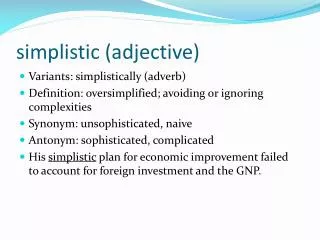
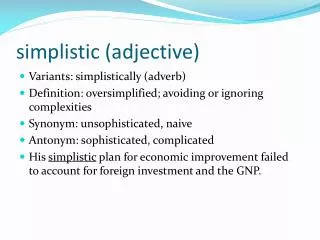
simplistic (adjective) • Variants: simplistically (adverb) • Definition: oversimplified; avoiding or ignoring complexities • Synonym: unsophisticated, naive • Antonym: sophisticated, complicated • His simplistic plan for economic improvement failed to account for foreign investment and the GNP.
incredulous (adjective) • Variants: incredulously (adverb); incredulousness (noun) • Definition: unwilling or unable to believe; showing disbelief • Synonym: skeptical • Antonym: credulous, gullible • The politician’s lavish promises provoked incredulous responses rather than the admiration he sought.
ascetic (adjective) • Variants: ascetically (adverb) • Definition: Reflecting self-denial (as in religious discipline); choosing minimal comforts • Synonyms: austere, Spartan • Antonym: self-indulgent, hedonistic • Her modest room reflected the ascetic values she advocated.
vicarious (adjective) • vicariously (adverb), vicariousness (noun) • Definition: Experienced through someone else rather than first hand; endured as substitute for someone else; delegated • synonym: second-hand [experience] • antonym: actual [experience] • Because she loved her son, she found vicarious pleasure in his tremendous successes.
allocation (noun) • Variants: allocate (verb), allocatable (adjective); allocator (noun) • Definition: the act of setting aside for a special purpose; designation • Synonym: allotment, apportionment • Antonym: abandonment • Sentence: The mayor insisted the park district include an allocation of land in order to build a playground. • The mayor insisted the parked district allocate land for a playground.
admonish (transitive verb) • Variants: admonishment (noun) • Definition: To caution, criticize, or counsel gently against • Synonym: chastise, reproach, rebuke • Antonym: approve, commend, praise • The anti-tobacco lobbyist admonished the President for his inability to quit smoking.
presumptuous (adjective) • presumptuously (adv.), presumptuousness (noun) • overconfident, excessively forward, taking too much for granted • Syn: arrogant • Ant: humble, modest • Darcy’s presumptuous manner understandably offends Elizabeth Bennet.
subversive (adjective,noun) • variants: subvert (verb), subversively (adverb) • Definition: tending or seeking to subvert, overthrow or destroy (an established government, institution, belief, etc) • Synonym: rebellious, disloyal • Antonym: loyal, faithful • Sentence: The Canadian government—indeed, the majority of Canadian citizens—believed the Nisei to be subversive operatives.
vacuous (adjective) • Variants: vacuously (adverb) • Definition: without contents, empty • Synonym: bare, blank, devoid • Antonym: full, abundant • Sentence: When the class looked at her with vacuous stares, the teacher knew the lesson had failed.
avocation (noun) • Variants: avocational (adjective) • Definition: something a person does in addition to a principal occupation, especially for pleasure • Synonym: pastime, hobby • Antonym: job, occupation • Sentence: Oddly enough, the math teacher’s avocation was the study of Old Norse epics.
impetus (noun) • Variants: • Definition: a moving force; impulse, stimulus • Synonym: encouragement, incentive, motivation • Antonym: hindrance, block • Sentence: Dr. Martin Luther King’s speeches were the impetus behind the civil rights movement.
reticent (adjective) • Variants: reticently (adverb), reticence (noun) • Definition: inclined to keep one’s thoughts and feelings to oneself, secretive, quiet • Synonym: reluctant, restrained, reserved • Antonym: communicative, forward, unrestrained • Sentence: The reticent student hid in the back row, unwilling to participate in the class discussion.
physiognomy (noun) • Variants: physiognomic (adj), physiognomically (adv) • Definition: The features of somebody’s face especially used as indicators of character or temperament. • Synonym: aspect, look, visage • Antonym: none • Sentence: In Great Expectations, Pip is frightened by the convict, for his physiognomy is menacing.
insipid (adjective) • Variants: insipidness (noun), insipidly (adverb) • Definition: without distinctive, interesting, or stimulating qualities • Synonym: bland, dull • Antonym: exhilarating • Sentence: Cauliflower’s insipid taste requires cheese or spices to make it palatable.
tedium (noun) • Variants: tedious (adjective), tediously (adverb) • Definition: quality or condition of being wearisome or boring • Synonym: dullness, monotony • Antonym: entertainment, excitement, diversion • Sentence: In order to take the tedium out of exercise, aerobic instructors rely on loud, exciting music.