Download
1 / 25
250 likes | 364 Vues
In this second advising session, we reflect on the first six weeks of the semester and plan for the remaining ten. What classes are you enjoying and which are challenging? We discuss time management, study tips, and essential resources available to help you succeed. Research shows that successful students utilize effective organizational skills, study groups, and proactive planning. Review your schedule, set a daily to-do list, and engage with resources like tutoring and academic advising to enhance your learning experience.

E N D
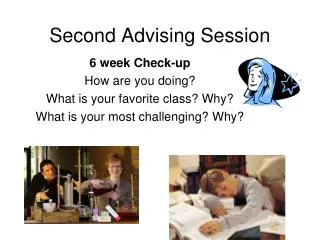
Second Advising Session 6 week Check-up How are you doing? What is your favorite class? Why? What is your most challenging? Why?
Timeline • You have completed 6 weeks of school • There are 10 weeks left in the semester • 9 weeks of class time • 1 week of finals • 6 WK 8 WK 15 WK 16 WK (Now) Midterm Classes Finals end
Plan your time well • Harvard Professor Richard Light compared successful and unsuccessful students and found three main differences. • Successful students had excellent • Time management skills • Organizational skills • Study groups
Time Management • 3 prong approach • Semester calendar for general overview ( put all dates for homework, quizzes, projects, tests, activities) • Weekly schedule-(when are your classes? when do you sleep? get up? study? Time for clubs, socializing, etc)-Map it out • Daily to do list- What are the specific actions i.e. read chap.1, do math problems 1-5
General study tips • Read & review before lecture. • Take notes during lecture. • Go over lecture notes right after class or as soon as you can. • Material is easier to remember when it’s fresh in your mind. Recall is better if you go over material within 24 hours. • Underline concepts and problems you don’t understand to ask TA or Professor
General Study tips • Do all of the suggested problems in the chapter • Don’t just review “how to do the problems” but try to understand the steps in completing the problems • The more problems you do, the better and faster you will be in solving problems on the test/quiz. • Test yourself to find out what you know and what you need to review (study group may help in this)
Reading a technical text book • Read the beginning and summary paragraphs for general ideas. • Read each subheading-list main ideas & concepts, formulas, etc. • Continually to mentally test yourself over what you have just read. (What, why, how) • Use different tools to gauge understanding (writing it, speaking it, hearing it, visualizing it) • Develop a crib sheet that you can use for studying • Use questions at the end of chapter, homework problems, predict essay questions using the information.
Where am I in the class? • Look at the syllabus-what is each test, lab, project worth? • Where are you in comparison to the rest of the class? On each exam? • top, middle, bottom • All instructors are supposed to give you an idea by the 8th week where you are in relation to the mean of the class. Below Above Mean
Remember • You can do it! • Get organized • See your Learning Assistant for a Time Management plan • Review your material • Be pro-active: seek out the TA, Professor • Don’t forget about tutoring, and ALAC • Come see me if you are having problems
Resources • Advising and Learning Center-Sage 2106 • Tutoring : Mon.- Thurs. 8-10 PM Check website http://alac.rpi.edu • Supplemental Instruction: • CHEMISTRY I : M & Tues 7-9 PM in CII 3051 • IEA : Mon. & Thurs. 6-8 PM in DCC 330 • Physics I: Mon. & Thurs. 8-10 PM in DCC 239
Other academic resources • Calculus help page http://calculus.math.rpi.edu/CalculusHelpF06.html (online videos of problems being solved, connects to all syllabi, office hrs.) • IEA & Physics- LMS pages have back exams with solutions. • Society of Physics students tutor students in Physics from 5:30-6PM on Wed. in Science Center 1C13.
Calculus Skills • CALC WORKSHOPS TAs & Tutors Monday- Thursday in CII(LOW) 4040 from 8-10 PM- Staff: tutors, TLAs& math TAs Go over HW, form study groups, affirm your math skills. No appointment necessary! Just Drop in& get your questions answered !
Center for Communication Practices at Rensselaer • Purpose: to provide one-on-one consultation for your written, oral, and electronic communication. • Web site: http://www.ccp.rpi.edu • Hours: Mon- Thurs.: 10 am-5 pm Fridays: 10 am-12 pm • Location: On the first floor of the Library • Go and get Feedback on your oral presentations and written work !
Dropping a class • When should you drop a class? • As soon as possible but before Friday, October 19th . • Why should you drop a class? • You are not interested in the class and it is not a required course • You are changing majors • You are not doing well in the class • You are taking too many classes/credits
Advantages: Focus on remaining classes Maintain your GPA Reduce stress Disadvantages One course behind Course is a pre-requisite for another required course (calc1 for calc 2) Might fall below 12 credits and full time status-(could affect financial aid) Dropping a class
How do I drop a class? • Log onto SIS • Go to add/drop class • Press submit to drop class • Go back to your schedule to confirm • If you have a hold on your account, you should click onto the link to view holds. That will tell you what kind of hold you have.
Holds • If you have a hold, you can still drop a class! Just not online. • You will need to go to Academy Hall to the Registrar’s office and fill out a late drop form. • The Registrar’s office will go onto SIS and drop the class for you.
What if I need to drop a class late? • The college catalogue says on page 73: • “It is the policy of the institute that no petitions be accepted for the retroactive dropping or adding a course except under extenuating circumstances beyond the student’s control” • This means- events and situations that are unexpected and beyond the student’s control. Most need documentation from the Dean of Student’s Office for approval.
Dropping a class late • Students cannot drop a class after the drop deadline because: • of failing or low grades • your professor recommends it • you changed your major • your parents said you should • the dog ate your homework
Class Concern email or EWS notice. What is it? • The Electronic Warning System identifies lack of performance in one or more of your classes. • Professors send the warning as a gauge for successful performance. • You receive it as an email. Your advisor, ALAC, and the Office of the First Year Experience receive it also. • This system alerts you to seek help and get back on track • As your advisor, I will email you to come in and talk to me about the class.
Health and Counseling Center • located on 3rd floor of Academy Hall • Health Center X6287 -0pened 7 days a week • Medical care • Allergy care • Health education Counseling Office X6479- opened 5 days on-call 24/7 • Relaxation training for anxiety • Improving communication skills • Improving study habits • Relating to parents • Helping with depression
Next advising Session • Tuesday,Oct. 30th • Topics to be covered: • Course registration for spring ‘13 • Humanities, Arts & Social Science Requirements • Dual, double, and minors • Study abroad offerings for spring & summer
Questions? • If no one has any questions, please fill out the information sheet and hand it to me when you are finished. • See you on Oct.30th same time and same place.