Trade and Aid
This overview explores the intricate relationship between Emerging Market Developing Countries (EMDCs) and Less Economically Developed Countries (ELDCs). EMDCs, representing the wealthier nations that control global resources, engage in trade with ELDCs which are less affluent and powerful. The text outlines essential trade concepts like imports and exports, the nature of raw materials versus manufactured goods, and various forms of aid: bilateral, multilateral, tied, and self-help schemes. It emphasizes the impact of globalization and the necessity of interdependence between nations in responding to economic disparities.

Trade and Aid
E N D
Presentation Transcript
EMDCs The ‘EMDCs’ are the ‘rich world’, that is those countries which control the world’s resources and generate much wealth.
ELDCs The ‘ELDCs’ are the ‘poor world’, that is those countries which are less powerful in world affairs.
Imports Imports are items which a country buys from other countries. A Country
Exports Exports are items which a country sells to other countries. A Country
Raw Materials Timber Oil Coal Crops Fish Raw Materials are items in a natural state, resources which are produced by nature, and which have not been altered in any way.
Manufactured Goods Manufactured Goods have been altered or processed in some way, normally in a factory.
Country Country C B Trade Countries exchange and buy and sell goods from each other. This is known as Trading. Country D Country A
Interdependence Countries depend on each other for many of the things which we need.
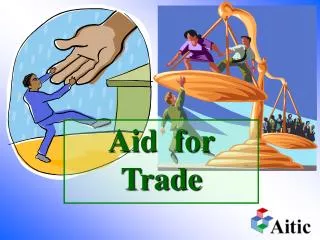
Aid EMDC ELDC Financial aid Aid is cash, materials or advice given by a rich country to a poorer nation
Bilateral Aid Bilateral Aid concerns aid given by one country to one other country.
Multilateral Aid Multilateral Aid concerns aid given by a group of countries to another country.
Tied Aid Tied Aid MUST be spent in the way the donating country says!
Short Term Aid Short Term Aid can be emergency aid, needed at times of disaster.
Long Term Aid Long Term Aid is given in the hope that the aid given will help the receivers for years to come.
Self Help Schemes Self help schemes are usually small scale, where aid given helps the receivers to help themselves in the future.
Small Scale/Large Scale Aid Some aid schemes are small scale, affecting small local areas. Some schemes appear to make a large scale change in the country, but often these changes only help a few, often the ‘rich’. Nowadays, small scale schemes often are more helpful to the poorest people. A NEW AIRPORT!
Globalisation The integration of national economies into the international economy through trade, foreign investment, ‘capital flows’, migration, and spread of technology.
Trade and Aid The End