
Gait Training with Body-Weight Support: An Analysis of Effective Support and Acceleration
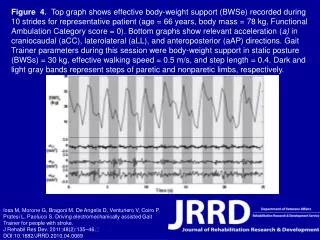
This study examines the efficacy of a gait trainer with body-weight support (BWS) in patients post-stroke. The top graph depicts effective body-weight support recorded over 10 strides for a representative 66-year-old patient with a functional ambulation category score of 0. The bottom graphs illustrate acceleration in craniocaudal, laterolateral, and anteroposterior directions during the session, which utilized a static body-weight support of 30 kg, walking speed of 0.5 m/s, and step length of 0.4 m. The findings highlight the impact of gait training on both paretic and nonparetic limb performance.

Gait Training with Body-Weight Support: An Analysis of Effective Support and Acceleration
E N D
Presentation Transcript
Figure 4. Top graph shows effective body-weight support (BWSe) recorded during 10 strides for representative patient (age = 66 years, body mass = 78 kg, Functional Ambulation Category score = 0). Bottom graphs show relevant acceleration (a) in craniocaudal (aCC), laterolateral (aLL), and anteroposterior (aAP) directions. Gait Trainer parameters during this session were body-weight support in static posture (BWSs) = 30 kg, effective walking speed = 0.5 m/s, and step length = 0.4. Dark and light gray bands represent steps of paretic and nonparetic limbs, respectively. Iosa M, Morone G, Bragoni M, De Angelis D, Venturiero V, Coiro P, Pratesi L, Paolucci S. Driving electromechanically assisted Gait Trainer for people with stroke. J Rehabil Res Dev. 2011;48(2):135–46. DOI:10.1682/JRRD.2010.04.0069