Disease Modeling Games for Understanding Epidemiology and Genetics
220 likes | 247 Vues
Engage students in hands-on games that simulate disease modeling, including concepts of epidemic spread, transmission modes, disease progression, and genetic factors. Explore the principles of epidemiology and genetics through interactive gameplay.


Disease Modeling Games for Understanding Epidemiology and Genetics
E N D
Presentation Transcript
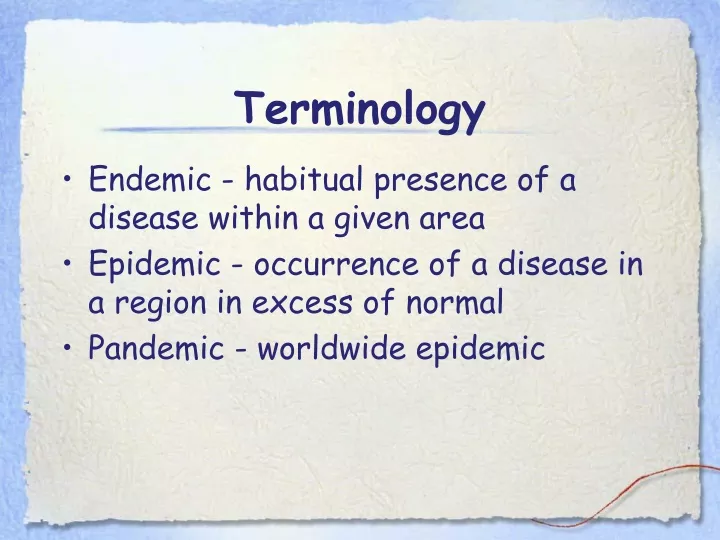
Terminology • Endemic - habitual presence of a disease within a given area • Epidemic - occurrence of a disease in a region in excess of normal • Pandemic - worldwide epidemic
Causes of diseases • Bacteria - single-celled, no nucleus • Virus - sub-microscopic infectious agent that can’t survive outside a host cell • Environmental - non-biological agent such as a toxic substance • Genetic - hereditary disease from genetic defects • Prion - Abnormal proteins • Protist - diverse group of eukaryotic microorganisms • Fungi and more
Modes of Transmission • Direct - person to person • Airborne transmission • Droplet transmission • Fecal-oral transmission • Sexually transmission • Blood-borne transmission
Modes of Transmission • Indirect - through a common vehicle or vector • Exposure to a contaminant (single, multiple or continuous exposure) • Vector-borne transmission
Examples • Virus with aerosol transmission • Measles, mumps, rubella • Bacteria with food/water transmission • Cholera, salmonella • Protozoan with vector-borne transmission • Malaria, giardia
Basic Model Concepts • Identify all stages of a given disease • Susceptible • Exposed • Infectious • Recovered / Removed • Vaccinated • Etc.
Basic Model Concepts • Identify disease progression • Link stages according to epidemiology of disease
S I R SIR • SIR - Chicken Pox
Learn by doing • Time for hands on games • Rules for games • Divide into groups of 4-6 students • Share responsibility for tasks • Don’t spill the beads!! • Ask any questions you have
Game #1 – Disease Modeling • Tasks: Cup holder, scribe, clear bead manager, blue bead manager, bead selector • Rules: • Start with 20 clear beads and 1 blue bead • Bead selector pulls out 2 beads (no peeking!!) • If 2 clear or 2 blue – put both back, if 1 clear and 1 blue – put 2 blues back • Repeat until time is up • Scribe counts final numbers
What did you get? • How many of each bead did you get? • Did everyone get the same results? • Why or why not?
Game #2 – Disease Modeling Revisited • Tasks: Cup holder, scribe, clear bead manager, blue bead manager, bead selector • Rules: • Start with 20 clear beads and 1 blue bead • Bead selector pulls out 2 beads (no peeking!!) • If 2 clear or 2 blue – put both back • If 1 clear and 1 blue, flip a coin. If heads, put 2 blues back, if tails, put 1 clear and 1 blue back • Repeat until time is up • Scribe counts final numbers
Modifications • Not always sick forever so could replace sick people with recovered people at some time • Could vaccinate people so they can’t get sick • Other ideas?
What about ecology? • Ecology has benefited from math for a longer time • Many ecology concepts are natural models such as predator-prey and competition • Again, looking at populations and flow rates between them
More games!! • Again often start from a simple hands on experiment links the math and biology more closely • Often send students out to • measure length and width of leaves • measure length of middle finger to height • Anything that teaches relationships
Game #3 Founder Effect • Tasks: Cup holder, scribe, clear bead manager, blue bead manager, bead selector • Rules: • Start with one blue bead and one clear bead • Bead selector pulls out 1 bead (no peeking!!) • If pull a blue bead, put two blues back into cup. If pull a clear bead, put two clear beads back into cup. • Repeat until time is up • Scribe counts final numbers
Founder Effect • What were the results? • What does that imply for genetics in isolated populations?
Game #4 Predator-Prey • Tasks: Rabbit breeder, Lynx, scribe • Rules: • Start with 3 rabbits spread across the meadow • Toss the lynx square once to catch rabbits • 3 rabbits = lynx survives and reproduces • All rabbits breed so double the number of rabbits and disperse across the meadow • If lynx doesn’t get 3 rabbits, it dies • If no lynx, one immigrates. If no rabbits, 3 immigrate • Repeat
Predator-Prey • Plot the numbers you got for lynx and rabbits in each generation • Can you predict how many there would be in the next generations?