Understanding Arcs and Chords: Key Theorems and Example Problems
This lesson explores the foundational theorems related to arcs and chords in circles. It covers three essential theorems: 1) If two chords are congruent, their corresponding minor arcs are also congruent. 2) A diameter or radius that is perpendicular to a chord bisects the chord and its arc. 3) Two chords are congruent if and only if they are equidistant from the center. The lesson provides worked examples illustrating these theorems, as well as sketching exercises to enhance comprehension of relationships within circles.

Understanding Arcs and Chords: Key Theorems and Example Problems
E N D
Presentation Transcript
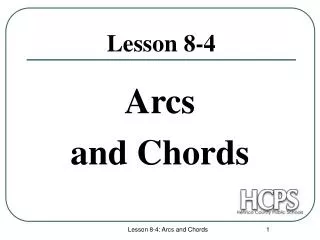
Arcs and Chords Lesson 8-4 Lesson 8-4: Arcs and Chords
A B E C D Theorem #1: In a circle, if two chords are congruent then their corresponding minor arcs are congruent. Example: Lesson 8-4: Arcs and Chords
D B A E C Theorem #2: In a circle, if a diameter (or radius) is perpendicular to a chord, then it bisects the chord and its arc. Example: If AB = 5 cm, find AE. Lesson 8-4: Arcs and Chords
D F C O B A E Theorem #3: In a circle, two chords are congruent if and only if they are equidistant from the center. Example: If AB = 5 cm, find CD. Since AB = CD, CD = 5 cm. Lesson 8-4: Arcs and Chords
15cm A B D 8cm O Try Some Sketches: • Draw a circle with a chord that is 15 inches long and 8 inches from the center of the circle. • Draw a radius so that it forms a right triangle. • How could you find the length of the radius? Solution: ∆ODB is a right triangle and x Lesson 8-4: Arcs and Chords
A B 10 cm 10 cm O C 20cm D Try Some Sketches: • Draw a circle with a diameter that is 20 cm long. • Draw another chord (parallel to the diameter) that is 14cm long. • Find the distance from the smaller chord to the center of the circle. Solution: ∆EOB is a right triangle. OB (radius) = 10 cm 14 cm E x 7.1 cm Lesson 8-4: Arcs and Chords