Hobbes' View of Morality: The Role of Prudence in Human Nature and Society
40 likes | 161 Vues
In Hobbes' view, morality is defined by prudence rather than intrinsic notions of "good." Human beings engage in rational behaviors to secure their own advantages and avoid the fear of death, seeking peace as a result. The State of Nature is a hypothetical scenario where all people are equal but live in a solitary and brutal existence without societal structure. To escape this chaos, individuals surrender their rights to a sovereign authority, creating a Commonwealth that ensures collective peace and defense through mutual covenants. Hobbes emphasizes the necessity of a strong, centralized power in maintaining order.


Hobbes' View of Morality: The Role of Prudence in Human Nature and Society
E N D
Presentation Transcript
Hobbes view of morality There is no “good” except prudence. (nominalist) We seek our own advantage (are rational) We fear death Fear of death leads us to seek peace We accept the “laws of nature” which are only theorems which any rational man would accept. “Men perform their covenants made.”
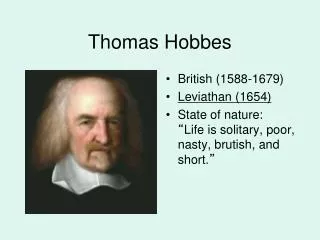
State of Nature • Hypothetical state before society • All people essentially equal. • “solitary, poor, nasty, brutish, and short” • Everyone has unlimited right to do whatever he wishes • What a person is entitled to do • What a person cannot be obligated to renounce
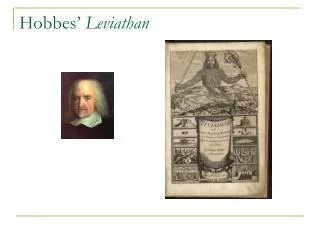
Commonwealth • Each individual transfers all rights to the sovereign • Brings about “Leviathan” “that mortal God to which we owe under the immortal God, our peace and defense. • Peace is maintained by the fear of death • Perpetual, undivided and absolute
commonwealth • “One person, of whose acts a great multitude, by mutual covenants one with another, have made themselves every one the author, to the end that he may use the strength and means of them all, as he shall think expedient, for their peace and common defence.”