Mastering Multiplication Facts: Patterns and Techniques for Easy Learning
370 likes | 496 Vues
Discover effective strategies for learning multiplication facts in "Learning the Multiplication Facts Part 1" by Monica Yuskaitis. This engaging resource introduces key patterns such as the Zero, One’s, Two’s, Five’s, Nine’s, and Six’s patterns, making it simpler to grasp multiplication concepts. Explore how to recognize patterns, use rhymes, and relate facts to known information. Perfect for students and educators seeking innovative methods to enhance math learning. Unlock the key to mastering multiplication with these helpful techniques!


Mastering Multiplication Facts: Patterns and Techniques for Easy Learning
E N D
Presentation Transcript
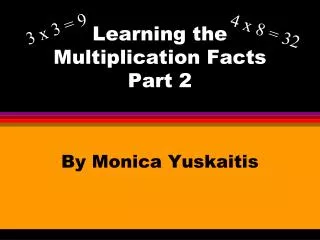
3 x 3 = 9 4 x 8 = 32 Learning the Multiplication FactsPart 1 By Monica Yuskaitis
Multiplication Factsare easiest to learn when... • You find patterns. • You use rhymes. • You use stories. • You relate them to what you already know.
Zero Pattern0 times any number is 0 • 0 x 3 = 0 • 0 x 7 = 0 • 0 x 4 = 0 • 0 x 1 = 0 • 0 x 0 = 0 • 0 x 9 = 0
What is 0 x 8 = 0
One’s Pattern1 times any number is the same number • 1 x 3 = 3 • 1 x 7 = 7 • 1 x 4 = 4 • 1 x 1 = 1 • 1 x 2 = 2 • 1 x 9 = 9
What is 1 x 5 = 5
Two’s Pattern2 times any number is thatnumber doubled • 2 x 3 = 6 • 2 x 7 = 14 • 2 x 4 = 8 • 2 x 1 = 2 • 2 x 2 = 4 • 2 x 9 = 18
What is 2 x 5 = 10
Five’s Pattern - Step 1Cut the number you are multiplying in half • 5 x 3 = 1.5 • 5 x 7 = 3.5 • 5 x 8 = 4 • 5 x 1 = .5 • 5 x 2 = 1 • 5 x 6 = 3
Five’s Pattern - Step 2 If you are multiplying an odd number, drop the decimal point 1 . 5 • 5 x 3 = • 5 x 7 = • 5 x 5 = • 5 x 1 = • 5 x 9 = 3 . 5 2 . 5 5 . 4 . 5
What is 5 5 x 7 = 3
What is 5 5 x 3 = 1
What is 5 5 x 9 = 4
What is 5 5 x 5 = 2
Five’s Pattern - Step 3 If you are multiplying an even number, just add a zero 1 • 5 x 2 = • 5 x 6 = • 5 x 4 = • 5 x 8 = • 5 x 10 = 0 3 0 2 0 4 0 5 0
What is 0 5 x 8 = 4
What is 0 5 x 6 = 3
What is 0 5 x 4 = 2
What is 0 5 x 2 = 1
Nine’s Pattern - Step 1Subtract 1 from number youare multiplying • 9 x 3 = 2 • 9 x 7 = 6 • 9 x 8 = 7 • 9 x 1 = 0 • 9 x 2 = 1 • 9 x 6 = 5
Nine’s Pattern - Step 2Add a 2nd number that totals nine with the 1st number • 9 x 3 = 2 • 9 x 7 = 6 • 9 x 8 = 7 • 9 x 1 = 0 • 9 x 2 = 1 • 9 x 6 = 5 7 9 + = 3 9 + = 2 9 + = 9 9 + = 9 8 + = 4 9 + =
What is 3 9 x 7 = 6
What is 2 9 x 8 = 7
What is 1 9 x 9 = 8
What is 4 9 x 6 = 5
What is 5 9 x 5 = 4
What is 7 9 x 3 = 2
What is 6 9 x 4 = 3
What is 8 9 x 2 = 1
Six’s Pattern (even #’s only)Step #1 Cut the number you are multiplying in half. • 6 x 2 = 1 • 6 x 4 = 2 • 6 x 6 = 3 • 6 x 8 = 4
Six’s Pattern (even #’s only)Step #2 The number you aremultiplying by 6 is the 2nd #. • 6 x 2 = 1 • 6 x 4 = 2 • 6 x 6 = 3 • 6 x 8 = 4 2 4 6 8
What is 6 6 x 6 = 3
What is 2 6 x 2 = 1
What is 8 6 x 8 = 4
What is 4 6 x 4 = 2