Introduction to Perl: Installation, Basics, and String Processing Techniques
This guide provides an overview of Perl, including why it's a preferred scripting language, especially for string processing and CGI scripts. It covers installation for Windows and Linux, along with a basic structure of Perl programs. Key concepts such as variables, operators, and regular expressions are introduced to help beginners understand how to write simple Perl scripts. Practical examples demonstrate the use of scalar and list variables, along with common array operations. Learn how to get started with Perl and harness its power in scripting.

Introduction to Perl: Installation, Basics, and String Processing Techniques
E N D
Presentation Transcript
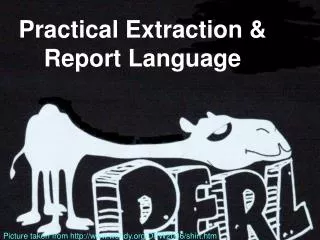
Practical Extraction & Report Language Picture taken from http://www.wendy.org/DPW2006/shirt.htm
Agenda • Why Perl? • Getting/Installing Perl • Using Perl • Structure of basic program (Hello world) • Variables & Operators • Regular Expressions • Other Topics
Why Perl • Perl is built around regular expressions • REs are good for string processing • Therefore Perl is a good scripting language • Perl is especially popular for CGI scripts • Perl makes full use of the power of UNIX • Short Perl programs can be very short • “Perl is designed to make the easy jobs easy, without making the difficult jobs impossible.” -- Larry Wall, Programming Perl
Getting/Installing Perl • Windows • www.activestate.com • Download “ActivePerl” • Run installer • Linux • Mostly installed when Linux is installed • userX@machineY$ which perl • Get it from • Linux distribution CDs • Update your installation and during package selection, select perl • ActiveState.com • CPAN
Other Possibilities • Using Virtual Machines • VMWare • Install VMWare workstation on windows • Install Linux under VMware workstation (select perl to be installed) • Cygwin • Install Cygwin on windows • It will provide a Linux interface such that perl can be used • http://www.cygwin.com/mirrors.html
Using Perl • Windows • Write a program and save it with .pl extension • C:\perl\bin>perl program_name.pl • Linux • Write a program and save it with .pl extension • userX@machineY$ perl program_name.pl • userX@machineY$ ./program_name.pl • Same under VMware & Cygwin chmod +x program_name.pl
Structure of a basic program First line is special, Path to perl installation this path can be different e.g., /bin/perl #!/usr/bin/perl # Program to do the obvious print 'Hello world.'; # denotes comment, any thing after # till the end of line is comment Statement ends with semicolon Built in function Function argument, in this case a string constant userX@machineY$ perl hello.pl
Variables • Scalar variables • Only one value at a time • List variables • List of values (Arrays)
Scalar Variables • The scalar variable means that it can store only one value. • They should always be preceded with the $ symbol. e.g., $var1 • There is no necessity to declare the variable before hand. (but recommended) • There are no data types such as character or numeric. If you treat the variable as character then it can store a character. If you treat it as string it can store one word . if you treat it as a number it can store one number.
Example scalar #!/perl/bin $x = "100\n"; print $x; $x = $x + 1; print $x; Output: 100 101
List/Array Variables • They are like arrays. It can be considered as a group of scalar variables. • They are always preceded by the @symbol. • eg @items = (“Apple",“Bell",“Chair"); • Like in C the index starts from 0. • If you want the second name you should use $items[1] • Watch the $ symbol here because each element is a scalar variable. • $# Followed by the list variable gives the length of the list variable. • $#items will provide index of last element @items • $len = @items; #will assign length of array to $len Is the result of two statements same$len = @itemsandprint @items ?
Example List/Array #!/perl/bin @myarray = (1721, 2974, “string"); print @myarray; $myarray[0]= “string”; $myarray[1]= “1234”; $myarray[2]= “5646”; print @myarray; print “$myarray[0]” . “$myarray[1]” . “$myarray[0]”;
Operations on Arrays • Push • push adds one or more things to the end of a list • push (@items, “table", “chair"); • push returns the new length of the list • Pop • pop removes and returns the last element • $myitem = pop(@items); • shift, unshift, reverse
Example (Push & Pop) #!/perl/bin @myarray = (1721, 2974, “string"); print “@myarray\n”; push(@myarray,”newval1”,”newval2”); print “@myarray\n”; $popvalue =pop(@myarray); print “$myarray\n”; print “@myarray”;
Operators • Arithmetic • String • Single and Double quotes • Conditional
Arithmetic in Perl $a = 1 + 2; # Add 1 and 2 and store in $a $a = 3 - 4; # Subtract 4 from 3 and store in $a $a = 5 * 6; # Multiply 5 and 6 $a = 7 / 8; # Divide 7 by 8 to give 0.875 $a = 9 ** 10; # Nine to the power of 10, that is, 910 $a = 5 % 2; # Remainder of 5 divided by 2 ++$a; # Increment $a and then return it $a++; # Return $a and then increment it --$a; # Decrement $a and then return it $a--; # Return $a and then decrement it
String and assignment operators $a = $b . $c; # Concatenate $b and $c $a = $b x $c; # $b repeated $c times $a = $b; # Assign $b to $a $a += $b; # Add $b to $a $a -= $b; # Subtract $b from $a $a .= $b; # Append $b onto $a
Single and double quotes • $a = 'apples'; • $b = 'bananas'; • print $a . ' and ' . $b; • prints: apples and bananas • print '$a and $b'; • prints: $a and $b • print "$a and $b"; • prints: apples and bananas
Conditions StringsNumbers eq == #equal to ne != #not equal to lt < #less than gt > #greater than le <= #less then or equal to ge >= #greater then or equal to Logical && #And || #Or ! #negation
Control structures • Loops • Foreach • For • while • Condition • If / else • Subroutines
foreach # Visit each item in turn and call it $myitem @item = (“item1”,”item2”,”item3”); foreach $myitem (@items) { print "$myitem\n"; }
for loops • for loops are just as in C or Java • for ($i = 0; $i < 10; ++$i){ print "$i\n";}
while loops #!/usr/local/bin/perl $a = 1; while ($a != 10) { $a++;}
do..while loops #!/usr/local/bin/perl $a = 1; do { $a++; } while ($a != 10);
if statements if ($a) { print "The string is not empty\n"; } else { print "The string is empty\n"; }
if - elsif statements if (!$a) { print "The string is empty\n"; } elsif (length($a) == 1) { print "The string has one character\n"; } elsif (length($a) == 2) { print "The string has two characters\n"; } else { print "The string has many characters\n"; }
Calling subroutines • Assume you have a subroutine printargs that just prints out its arguments • Subroutine calls: • printargs(“arg1", “arg2"); • Prints: “arg1 arg2" • $returnvalue =printargs(“arg1", “arg2"); • Prints: “arg1 arg2“ • $returnvalue will be assigned two
Defining subroutines • Here's the definition of printargs: sub printargs{ print "@_\n"; } • Parameters are put in the array @_ which can be accessed using • $_[0], $_[1] etc How many parameters are passed to sub routine?
Returning a result • Use return statement sub maximum { if ($_[0] > $_[1]) { return $_[0]; } else { return $_[1]; } } $biggest = maximum(37, 24);
Basic pattern matching • $sentence =~ /the/ • True if $sentence contains "the" • $sentence = "The dog bites.";if ($sentence =~ /the/) # is false • …because Perl is case-sensitive • !~ is "does not contain"
RE special characters . # Any single character except a newline ^ # The beginning of the line or string $ # The end of the line or string * # Zero or more of the last character + # One or more of the last character ? # Zero or one of the last character
RE examples ^.*$ # matches the entire string hi.*bye # matches from "hi" to "bye" inclusive x +y # matches x, one or more blanks, and y ^Dear # matches "Dear" only at beginning bags? # matches "bag" or "bags" hiss+ # matches "hiss", "hisss", "hissss", etc.
Other Topics • Split() and join() • File handling • Perl 5 • Modules • http://www.pageresource.com/cgirec/index2.htm