Understanding MBO, MBI, LBO, and Financing Types in Corporate Acquisitions
This glossary provides definitions for key financial terms related to corporate acquisitions, including Management Buy-Out (MBO) where a company's management gains full control, and Management Buy-In (MBI) where external managers do so. It also covers Leveraged Buy-Out (LBO), a technique using minimal equity and significant debt, and Leveraged Management Buy-Out (LMBO) which heavily relies on debt. Additionally, it explains junior debt, senior debt, and mezzanine financing, illustrating the varying levels of risk associated with each debt type.

Understanding MBO, MBI, LBO, and Financing Types in Corporate Acquisitions
E N D
Presentation Transcript
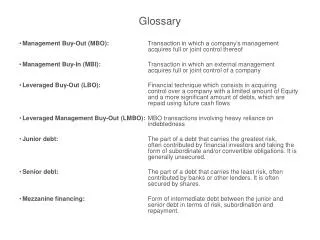
Glossary • Management Buy-Out (MBO): Transaction in which a company’s management acquires full or joint control thereof • Management Buy-In (MBI): Transaction in which an external management acquires full or joint control of a company • Leveraged Buy-Out (LBO): Financial technique which consists in acquiring control over a company with a limited amount of Equity and a more significant amount of debts, which are repaid using future cash flows • Leveraged Management Buy-Out (LMBO): MBO transactions involving heavy reliance on indebtedness • Junior debt: The part of a debt that carries the greatest risk, often contributed by financial investors and taking the form of subordinate and/or convertible obligations. It is generally unsecured. • Senior debt: The part of a debt that carries the least risk, often contributed by banks or other lenders. It is often secured by shares. • Mezzanine financing: Form of intermediate debt between the junior and senior debt in terms of risk, subordination and repayment.