Understanding Transpulmonary Pressures and Lung Mechanics During Expiration
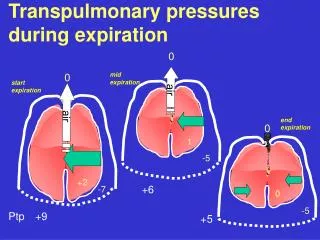
This article explores the concept of transpulmonary pressures and their role during different phases of expiration in the lungs. It examines the importance of negative pleural pressure at end-expiration, surfactant secretion by Type II alveolar cells, and how these components prevent lung collapse. By discussing Laplace's Law and the effects of interfacial tension, the implications of alveolar mechanics on lung volumes, including tidal volume and functional residual capacity, are also highlighted.

Understanding Transpulmonary Pressures and Lung Mechanics During Expiration
E N D
Presentation Transcript
Transpulmonary pressures during expiration 0 midexpiration air 1 -5 0 startexpiration air end expiration 0 +2 +6 -7 0 -5 Ptp +9 +5
What keeps the lung inflated at end-expiration? • The negative Ppl
end expiration 0 -5 Lungs collapse if chest is opened
What keeps the lung inflated at end-expiration? • 2. Alveolar surfactant • (phospholipid secreted by alveolar type II cells)
alveolar space type II cell type I cell The alveolar air-water interface Type I water Type II
Type I Laplace: If Palv constant, T 1 water Alveolar radius Type II Air-water interfacial tension T Palv T air water
T 1 Alveolar radius Alveolar surfactant decreases air-water tension Type I T Palv T air Type II water
Lung volumes total lung capacity residual volume 1.5 L 6 L inspiratory volume functional residual capacity inspiration expiration 3 L tidal volume (500 ml)