Metrology and Stabilization for Linear Collider Advancement
This document presents an overview of WP7 pertaining to metrology and stabilization in the context of linear collider projects. Key purposes include survey and alignment to monitor site characteristics and stabilize critical components against vibrations. The report provides insights into rapid testing and automation techniques for accurate measurements, ensuring component stability for optimal luminosity. Cooperation among institutes, robust research, and innovative methodologies are crucial for improving alignment processes and the overall performance of collider systems, within a 3-year developmental framework.

Metrology and Stabilization for Linear Collider Advancement
E N D
Presentation Transcript
Metrology and StabilisationWP7 Y.Karyotakis Annecy-Le-Vieux (LAPP) November 1st, 2004
Purpose • Survey and alignment • Stabilisation • Site characterisation WP7
Overview • Relevance for the LC • Survey and Alignment: • First use in tunnel construction, determine settling, place component foundations • Second use in component placement • Continuous use during operation to track drifts, settling, component changes and other position related problems • Stabilisation • First impact in choice of site. How much vibration can we suppress with active and passive measures? • How many feedback systems do we need and how do they interact? • Influence on FF magnet design (vibration modes and sources) • FF stability is critical for luminosity stabilisation • Accurate FF placement reduces time from beam on to max luminosity, especially after detectors are opened and closed WP7
Tasks • RTRS • Fast reliable accurate survey techniques • Components’ location monitoring • MSTBT • Active stabilisation • PGMS • Vibration spectra @ potential LC sites WP7
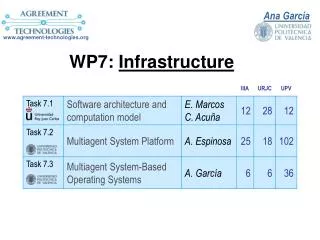
Institutes • UOXF.DLRTRS / MSTBT • LAPP MSTBT • CCLRC PGMS • DESY PGMS WP7
MSTBT goals Mechanical stabilise critical components • Inertial and optical sensors • Actuators (Piezo, electrostatic,….) • Fast feedback Loop • Modeling (FE and dynamic analysis. Full simulation of the process) • Mockup demonstrator WP7
MSTBT work share • Oxford • Optical sensor development (M-FSI = Michelson interferometry combined with FSI) with nm resolution • Fast, cost effective custom readout and DAQ • Push frequency reach of sensors up to O(10 kHz) by multi fibre phase measurement technique • LAPP • Inertial sensors survey and development (~1-300Hz) • Actuators • Feedback loop • Mechanical modeling • Mockup simulation and construction WP7
MSTBT deliverables • Full modeling of the process • Build a prototype of 3-DOF stabilisation unit based on M-FSI technology and test with various actuators. • Build a mockup of a FF magnet, measure vibrations, compare with model, stabilise it Should take ~ 2 years WP7
RTRS goals • Provide Metrology and Alignment process for the complete collider (3-step process) • Step 1: Rapidly perform collider reference survey with maximal automation (Metrology, RTRS=Rapid Tunnel Reference Surveyor) • Step 2: Survey collider components against reference (automated stake-out instrument(s)) • Step 3: Adjust collider geometry allowing save insertion of beams (Alignment, manual in main linac, possibly automated for very sensitive elements) • Provide rapid, accurate measure of geometry at any time with minimal reduction of up-time (Diagnostic function) WP7
LiCAS Principle Internal FSI System Dz. & Dx,Dy & Da,Db between cars Extrenal FSI System measures Wall marker location Straightness Monitor Dx,Dy & Da,Db between cars WP7
RTRS (2) • Oxford & DESY Applied Geodesy group • Develop complete sensing system for RTRS based on • FSI: Frequency Scanning Interferometry for absolute distance measurements • LSM: Laser Straightness Monitors WP7
RTRS deliverables • Build a 3-car prototype RTRS, operate in DESY test tunnel by middle 2006 • Aim to be usable in X-FEL • Develop automatic stake out instrument WP7
PGMS • Natural Cultural noise • Site dependence • Develop reliable nm measurement techniques over large domain of frequencies DESY and CCLRC WP7
Conclusion • Stabilisation is a new dimension to take into account for a Linear Collider • Need to develop fast and reliable alignment techniques • Important contribution from participating institutes and EU • Solid R&D program over the next 3 years WP7