The Solar System
Discover the Sun, planets, dwarf planets, moons, asteroids, and comets in our Solar System. Learn about the Sun's layers and special features, as well as details on each planet's unique characteristics. Dive into the Inner and Outer Planets to understand their composition and individual traits. Explore asteroids, comets, and dwarf planets like Pluto, Eris, and Ceres. Engage in a fascinating journey through our cosmic neighborhood!

The Solar System
E N D
Presentation Transcript
The Solar System By: Seemani Dash
What is the Solar System? Our focus question:
Vocabulary for this Chapter • star: a huge ball of very hot, burning gas that gives off energy • ellipse: a shape like an oval • satellite: an object that orbits another object in space
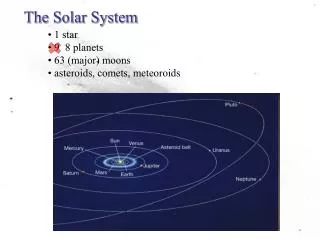
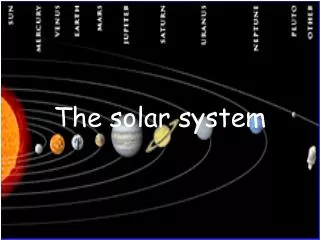
What is our Solar System Made of? • The Sun • Eight planets • Dwarf planets • Moons • Asteroids • Comets
What is the Sun? • An average sized star made mostly of hydrogen and helium • The central and largest body in our solar system • Takes up almost 99% of the mass in our solar system • Very hot with no solid surfaces • Has three layers: the photosphere, the chromosphere, and the corona • Has three special things: sunspots, prominences, and solar flares
Planets • a large, round object that revolves around a star • cooler and smaller than stars • shine because the light of the star reflects off the planet’s surface • stay in their elliptical orbit around the star because of gravity • eight known planets in solar system
What are the Inner Planets? • the four planets closest to the Sun • the four smallest planets
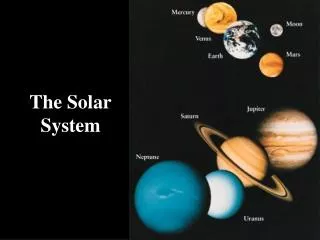
Mercury • 1st planet from the Sun • has no moons • has thousands of craters • almost no atmosphere • very hot at day • freezing cold at night
Venus • 2nd planet from the Sun • about the same size as Earth • rotates in the opposite direction than the other planets • has an atmosphere of thick, poisonous, and swirling clouds • Sun reflects off clouds, so the planet is one of the brightest objects in the sky
Earth • 3rd planet from the Sun • only planet with liquid water • atmosphere supports life • largest rocky planet in the solar system • one moon that has many craters
Mars • 4th planet from the Sun • has two deeply cratered moons • sometimes called the “Red Planet” because of soil that contains iron oxide • dust storms occur • has polar ice caps • many volcanoes • many probes landed on this planet
What are the Outer Planets? • the four planets farthest from the Sun • the four largest planets The “Gas Giants”, and the planets with rings
Jupiter • 5th planet from the Sun • largest planet in the solar system • atmosphere made mostly of hydrogen and helium • at least 63 moons • has a large storm called the great red spot
Saturn • 6th planet from the Sun • has a low mass • has visible rings made of ice, dust, and rock • at least 47 moons
Uranus • 7th planet from the Sun • atmosphere consists of hydrogen, helium, and methane • methane can become a liquid and makes a cloud that gives the planet a bluish color • at least 27 moons • rotates on its side
Neptune • 8th planet in the solar system • smallest of the gas giants • has one huge storm called the “Great Dark Spot” • at least 13 moons
Asteroids • rocky object up to hundreds of kilometers long • sometimes called minor planets • most are found in between Mars and Jupiter, in the asteroid belt • some asteroids have smaller asteroids orbiting the bigger ones This is Eros. This is Ida Examples
Comets • frozen mass of different kinds of ice and dust • much smaller than planets • have two tails, outward moving particles from the Sun always push tails in a direction away from the Sun This is a close look at a comet.
Dwarf Planets • it is a small, ball shaped or round object that revolves around the Sun • Pluto, Eris, and Ceres are all dwarf planets • Pluto orbits the Sun in a tilted ellipse Pluto Eris Ceres
References • 5th grade science book