Download
1 / 27
270 likes | 394 Vues
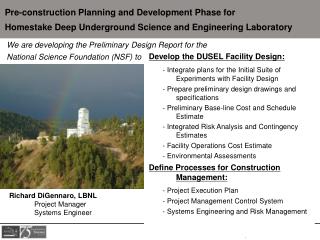
This document outlines the strategic roadmap for the development of the Deep Underground Science and Engineering Laboratory (DUSEL). It discusses the motivation behind the science and engineering program, emphasizing cost management, modularization, and site evaluation. Key topics include infrastructure design criteria, compliance with fire and life safety codes, and the integration of diverse scientific programs. The roadmap also highlights short-term goals, necessary steps for design, and the interplay of infrastructure with site characteristics essential for research.

E N D
DUSEL Development Process:The Roadmap from Science & Engineering Plan to the Facility Description Lee Petersen, CNA Consulting Engineers Dale Holland, Dunham Associates Greg Hulne, Miller-Dunwiddie Architects
Motivation • Science/Engineering Program Cost • Input to Site Advocates • Framework for Modularization • Framework for Site Evaluation CNA - DA - MDA
Motivation: Science/Eng Cost CNA - DA - MDA
Topics • What is infrastructure? • Short-term roadmap (design process) • Infrastructure matrices • High-level design criteria • Design codes & the implications • Next steps CNA - DA - MDA
What is “infrastructure”? • Traditional definition: • Grouping of science & engineering functions into modules • Sequence, expansion, reuse • Excavations, systems & services to support science • Design must satisfy fire & life safety codes • But “infrastructure” also includes: • Site characteristics necessary for conducting the science & engineering program • Rationale for depth, rock type, stress, groundwater, etc. CNA - DA - MDA
DUSEL Development Sequence • Develop Science & Engineering Research Plan • Collect Technical Requirements • Design criteria • Site character, grouping, sequence & infrastructure) • Timeline issues • Relationship Matrix • Illustrates compatibilities and incompatibilities • Relationship Diagramming • Illustrates spatial relationships CNA - DA - MDA
HLDC in the Design Pyramid CNA - DA - MDA
DUSEL Design Criteria • Science Design Criteria • Public Access • Occupancy • Codes & Standards • General Access • Schedule • Experiment Isolation CNA - DA - MDA
Infrastructure for Physics CNA - DA - MDA
Infrastructure for Earth Science CNA - DA - MDA
Site Characteristics-Earth Science CNA - DA - MDA
Site Characteristics-Earth Science CNA - DA - MDA
Relationship Matrix CNA - DA - MDA
Timeline Issues • Sequence, expansion, remodeling • Characterization • Necessary for design • Integration with Geo & Bio science program • Shared or single purpose caverns • Funding profile • Shared use of accessways • Experiment operations & new construction • Hazardous materials & life safety CNA - DA - MDA
Fire & Life Safety Codes • Role of FLS codes in design • Code environment (past, present, future) • Code applicability • Basic code requirements • Implications • Key first steps for sites • Issues to be resolved CNA - DA - MDA
Role of FLS codes in design • Codes represent the aggregate knowledge of the industry • Codes are a starting point, but don’t cover special hazards • Codes: • Are national standards • Are minimum requirements • Are statutory • Impact layout & concept • Code variances occur, but are jurisdiction-specific CNA - DA - MDA
Codes • Prior or current codes: • Uniform Building Code • Uniform Fire Code • Uniform Mechanical Code • Current or Future codes: • International Building Code • International Fire Code • International Mechanical Code • National Fire Protection Assoc. • Highway Tunnel Codes • Mine Safety & Health Admin Codes • OSHA • ADA CNA - DA - MDA
Example of some changes from UBC to IBC • Air changes per hour • Was 8 ach, now 6 ach • Compartmentalization • Was 1 compartment, now minimum 2 • Fire separation • Was 2 hr, now 1 hr • Independent air supply systems • Was central system, now compartmentalized CNA - DA - MDA
Current Code Environment • California: ???? IBC • Colorado: 1997/1991 UBC • Minnesota: 2000 IBC • New Mexico: 2003 IBC • South Dakota: ???? IBC • Virginia: 2000 IBC • Washington: 2003 IBC CNA - DA - MDA
Preliminary applicability CNA - DA - MDA
Role of the Local Code Official • Identify Authority Having Jurisdiction (AHJ) • Academic institution • City • County • State • DUSEL-like facilities are outside the experience of most AHJs CNA - DA - MDA
Minimum Requirements • Construction materials • The underground portion of the building shall be of Type I construction. (3) • Hazard requirements • Building use hazards • Egress • Smokeproof enclosures • Exit Ventilation • Areas of Refuge (3) IBC Section 405.2 CNA - DA - MDA
Minimum Requirements • Smoke ventilation • Compartmentalization • Smoke Venting Systems • Alarm Systems • Fire Protection • Sprinklers • Standpipes • Fire Alarm • Smoke Detection • Alarm System CNA - DA - MDA
Minimum Requirements • Power systems • Standby Power • Emergency Power • Emergency Illumination CNA - DA - MDA
Issues to Resolve • Egress & refuge • Cryogen & other hazards • Requires special treatment • Fire hazards • Integration of diverse codes at diverse sites • Building • MSHA • Highway tunnel CNA - DA - MDA
Critical next steps • Develop Science & Engineering Research Plan • Collect Technical Requirements • Design criteria • Site character, grouping, sequence & infrastructure) • Timeline issues • Relationship Matrix • Illustrates compatibilities and incompatibilities • Relationship Diagramming • Illustrates spatial relationships CNA - DA - MDA
Motivation (review) • Science/Engineering Program Cost • Input to Site Advocates • Framework for Modularization • Framework for Site Evaluation CNA - DA - MDA