Circular Motion
This overview explores the concepts of circular motion, focusing on centripetal force, apparent weight, and Newton's Universal Law of Gravitation. It explains centripetal acceleration as the center-seeking acceleration, how it relates to force exerted by central bodies, and the implications of apparent weight in scenarios like elevators and space stations. The relationship between centripetal force and gravitational force is analyzed, leading to Kepler's laws of planetary motion, emphasizing the mathematical connections that allow us to deduce the mass of celestial bodies.

Circular Motion
E N D
Presentation Transcript
Circular Motion Centripetal Force Apparent Weight Newtons’ Universal Gravitation Law
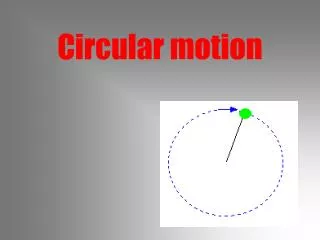
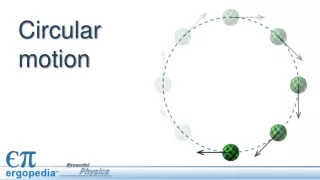
Centripetal accel. & Force • v = 2pr/T • acp = v2/r • Fcp = mv2/r • Centripetal = center seeking. acp & Fcp are both toward the central body. • Fcp is the force exerted by the central body on the orbiting body. (Recall Newton’s 3rd) • acp is the accel. of the orbiting body caused by that force. • Direction of v?
Centrifugal • p. 156 text - “A Nonexistent Force” • This is not really true - just misused. • Centrifugal = center fleeing • Force exerted by orbiting body on the central body • Newton’s 3rd - axn/rxn forces
Apparent Weight • What the weight of an object appears to be as a result of the acceleration of a supporting. • Faw = m(g-a) • Ex. of supporting bodies - elevators & space stations & rockets - oh my! • When an orbiting body is accel. @ a rate of g weightlessness occurs.
Newton’s Universal Law of Gravitation • Fg = Gm1m2/r2 • For earth: Fg = GMem/r2 • Fg is also wt. therefore, mg = GMem/r2 • mg = GMem/r2 • g = GMe/r2 • What does this tell us?
Usefulness of Newt’s Univ. Grav. Law. • Observation Fcp ≠ one of the fundamental forces • Sometimes Fcp = Fg • Knowing when is the key! • If mass is the cause of the force then Fcp = Fg • Therefore, mv2/r = GMem/r2 • mv2/r = GMem/r2 • v2/r = GMe/r2 & v2 = GMe/rthus v = GMe/r
Usefulness of Newt’s Univ. Grav. Law. • But v = 2pr/T • So 2pr/T = GMe/r • thus4p2r2/T2 = GMe/r • and 4p2r3/T2 = Gme so 4p2r3 = GMeT2 • T2 = 4p2r3/Gme • T = 2p r3/Gme
Usefulness of Newt’s Univ. Grav. Law. • Therefore, we can determine all sorts of information about central & orbiting bodies if we know other information. • This is how they know the mass of the sun & planets & moons etc.
Kepler’s 3rd Law • T2/R3 = k • Applies to any given orbited or central body.
Newt’s Univ. Gav. Law & Kepler’s 3rd Law. • 4p2r3/T2 = Gme • Since4p2 & Gme areall constant • r3/T2 or T2/r3 = k which is Kepler’s 3rd law. • Although Kepler (1571-1630) preceded Newton (1643-1727). Kepler’s 3rd Law follows from Newton’s Universal Law of Gravitation.