Sensing & Separation
In software testing, particularly unit testing, we often face challenges due to dependencies on hardware or external systems. This chapter addresses the "sensing and separation" problem, which involves breaking dependencies to facilitate testing when such hardware isn’t available. By using fake objects and mock objects, we can simulate dependencies, allowing us to test our code effectively. The chapter covers examples, including the implementation of mock objects, and emphasizes the importance of crafting tests that, while they may not cover everything, provide a close approximation of system behavior.

Sensing & Separation
E N D
Presentation Transcript
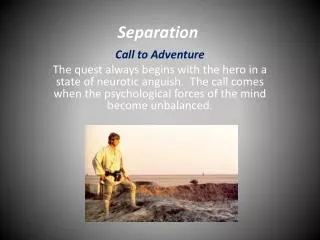
Sensing & Separation Feathers Ch 3 Steve Chenoweth, RHIT
How to break dependencies • Sensing – Break dependencies in order to sense, whenever we can’t access values our code computes. • Separation – Break dependencies to separate when we can’t even get a piece of code into a test harness to run. Right – You can’t test the sled unless the dogs are in the harness! Q10
E.g., public class NetworkBridge { public NetworkBridge(EndPoint [] endpoints) { … } public void formRouting(String sourceID, String destID) { … } … } How do we write tests for this? What if the hardware is not available? This is the “sensing and separation” problem.
So, we Fake collaborators • Like the “Mock Objects” you studied in 376: • A mock object is a fake object in the system that decides whether the unit test has passed or failed. • In general, a “Fake Object” impersonates some collaborator of your class, when your class is being tested.
Fake Tests are Real Tests • May not show everything, but • We try to get close! • We hope for small, well-understood pieces. Right – Is the chocolate working for you? How about the berries? Q11
Example import junit.framework.*; public class SaleTest extends TestCase { public void testDisplayItem() { FakeDisplay display = new FakeDisplay(); Sale sale = new Sale(display); sale.scan(“1”); assertEquals(“Milk $3.99”, display.getLastLine3()); } }