Behaviour Based Robotics
This project explores behavior-based robotics, where autonomous robots respond to their environments using various sensors. By simulating a cleaning robot capable of distinguishing between 'grass' and 'dirt' in a virtual world, we aim to develop software that allows dynamic interaction and environment alteration. Leveraging Lego NXT technology and employing techniques like blob detection, we achieved successful navigation and obstacle avoidance. Our work illustrates the connection of physical robots with virtual reality, redefining programming education to be engaging and accessible.

Behaviour Based Robotics
E N D
Presentation Transcript
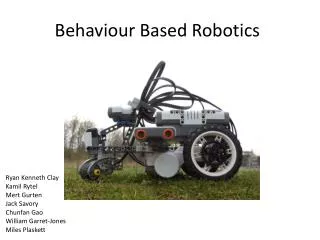
Behaviour Based Robotics Ryan Kenneth Clay Kamil Rytel Mert Gurten Jack Savory Chunfan Gao William Garret-Jones Miles Plaskett
Robots we use today Automated production lines Robotic surgery Automated motor vehicle e.g. Mars Rover Cleaning robot e.g. Roomba Robotic lawnmower
What is a ‘Robot’? ‘A machine capable of carrying out a complex series of actions automatically, especially programmable by a computer.’ (Oxford Dictionary) An autonomous robot can make actions without direct user control. It has the ability of self-government. Behaviour-based robots exhibit actions that are modelled by its environment. The robot can ‘sense’ the world through the various sensors
The Task Design a robot with the ability to respond to an artificially created environment. The robot has to: work in an environment created by a projector roam and detect ‘grass’ or ‘dirt’ explore 'grass'/'dirt' in order to ‘clean’ it up avoid virtual (projected) and physical obstacles Develop a software that would create the virtual world User Interface: map creation and preview Backend: blob detection and environment alteration
Sensors Used In The Project Light sensor Colour sensor Sonar
The UI backend Initial idea of using Python Implemented using OpenCV library for java The blob detection Uses Hough Circle Transform, a general technique for identifying the locations and orientations of certain types of features in a digital image. When the circle is detected, green colour in that area is being removed, which simulates the 'dirt'/'grass' removal.
Achievements? Completely new experience: work with a 'real world' robot – not just software simulation on the screen Connection of the real world (robot) with the virtual reality (projected maps) Dynamic alteration of the virtual world Successful ending of the project despite the problems faced
The future Robots usage in programming teaching Lego NXT can be easily programmed It is faster and easier to program the robot, therefore to understand the problem and the code Using robots (especially Lego NXT) can show that programming can be fun, not just boring code on the screen
The future Robotics is developing AI involvement Sensor precision Interaction with software Different approaches, methodologies – a big field for research