CrossRef - a DOI Implementation for Journal Publishers
This document outlines the role and mission of CrossRef as a non-profit membership association providing DOI registration services for journal publishers. It details how CrossRef facilitates citation linking through its metadata database, allowing seamless access to scholarly content across various platforms. By utilizing a standardized DOI system, CrossRef enhances the reliability of links in scholarly literature. Additionally, it highlights the benefits of CrossRef's infrastructure in maintaining persistent links and supporting various content types, essential for modern academic publishing.

CrossRef - a DOI Implementation for Journal Publishers
E N D
Presentation Transcript
CrossRef - a DOI Implementation for Journal Publishers January 29, 2003 CENDI Workshop
CrossRef - a DOI Implementation for Journal Publishers X X Scholarly January 29, 2003 CENDI Workshop
CrossRef’s Mission • To provide services that bring the scholar to authoritative primary content, focusing on services that are best achieved through collective agreement by publishers
CrossRef’s Role • Non-profit membership association • DOI Registration Agency • Registration of metadata and unique, persistent identifiers • Representation on IDF Board, TWG and RAWG • Reference linking service • Standards and Guidelines • Rules governing metadata and linking • DOI Guidelines – using DOIs
What Does CrossRef do? • Uses DOI system to make linking scholarly content (journals, conference proceedings and books) efficient, manageable, and reliable • Links are between online journals, from secondary database records and from library pages • Outbound links: add end-user utility to content • Inbound links: bring more users to content • CrossRef provides a citation linking backbone for all scholarly literature in electronic form
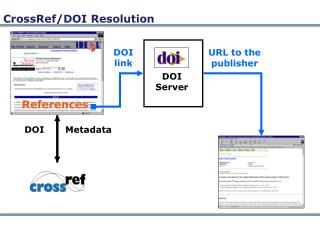
How does CrossRef work? • Publishers deposit metadata (in XML), including a DOI and URL, in CrossRef metadata database • Members and affiliates then send references to query the central metadata database to find the DOI for the cited article • If there is a match, they retrieve the DOI and add it to their electronic record and create a link ...
How does CrossRef work? • In an online article, a researcher sees and clicks the DOI link (it may say “CrossRef” or just “Article”) • The DOI resolves to the URL registered by the publisher • terms of access to the full text are set by the publisher -- in most cases, if the user is entitled to access, she goes straight to the full text of the article • Most publishers take non-subscribers to the abstract • Full bibliographic citation and information on getting the article at a minimum
DOI Directory Suffix http://dx.doi.org/ 10.1006/jmbi.1995.0238 Prefix http://www.idealibrary.com/links/doi/10.1006/jmbi.1995.0238
Linking as navigation at the content level across publishers
Key benefits of the CrossRef system • As technology infrastructure for linking • Efficient, persistent links - no stale links in citations or database records • Average half-life of a URL is 44 days • Publishers update URLs in one location; about 50% of the records in CrossRef have already been updated • Interoperability with other numbering schemes – ISSNs, SICIs, PIIs, etc. • Standardized metadata and services
Key benefits of the CrossRef system • As business infrastructure for linking • Membership agreement sets rules and creates level playing field - no bilateral agreements needed • Publishers maintain their own business models • Collaborative environment for new developments
Current Stats • 177 Members (91 in September 2001, 33 in June 2001) • 23 Affiliates/8 Agents/60 Libraries • 6.6 million DOIs (3.7 million DOIs December 2001, 1.3 DOIs June 2000) • 6900 journals represented (2700 June 2000) • 2 million DOI resolutions/month (600,000 - 900,000 in December 2001)
Recent Developments • Expansion of content types • conference proceedings and books/reference works • enable citation linking and drive traffic to proceedings papers and book chapters. • Parameter Passing • Extra information sent along with a DOI to: • (1) track originating journal (2) customize response pages (3) add return buttons, (4) institute special trading rules • OpenURL format being used for parameters • http://dx.doi.org/resolve?<OpenURL parameters>
DOIs and OpenURL • OpenURL is not an alternative to CrossRef and DOIs – they work together • The DOI system and CrossRef are OpenURL aware and therefore publishers are OpenURL through use of CrossRef and DOIs. • CrossRef and the DOI system are OpenURL – and so are publishers who use DOIs • DOIs and CrossRef are integrated with localized linking/OpenURL linking systems (SFX, LinkFinderPlus, Z Portal)
Trends and Developments • Digitization of older articles • Users expect things to be instantaneous/real-time • Publishing workflows must change • “hourly” publishing model • The Article Economy • Journal issue deconstruction is accelerating • Users expect easy access - pay-per-view more common • Article-by-article online publishing (volumes, issues and print follow later) • E-article is article “of record”
Conclusion • Collaboration and standards are necessary to meet user demands • The IDF has done an immense amount of work to build a very open, flexible system that builds off the Handle system • Join the IDF – it’s not just for publishers
CrossRef • the central source for reference linking • Linking Scholarly Communities Together • http://www.crossref.org • Ed Pentz • epentz@crossref.org