Comprehensive Lab on Chemical Reactions and Equations
This lab, designed for high school chemistry students, guides participants through the observation and analysis of seven chemical reactions, focusing on identifying reactants and products, as well as balancing chemical equations. The lab consists of three parts, where students will engage in hands-on activities, making observations on changes such as color shifts, gas evolution, and precipitate formation. Students will also complete word equations and classify the types of reactions encountered. This immersive experience aims to deepen understanding of chemical processes and reaction equations.

Comprehensive Lab on Chemical Reactions and Equations
E N D
Presentation Transcript
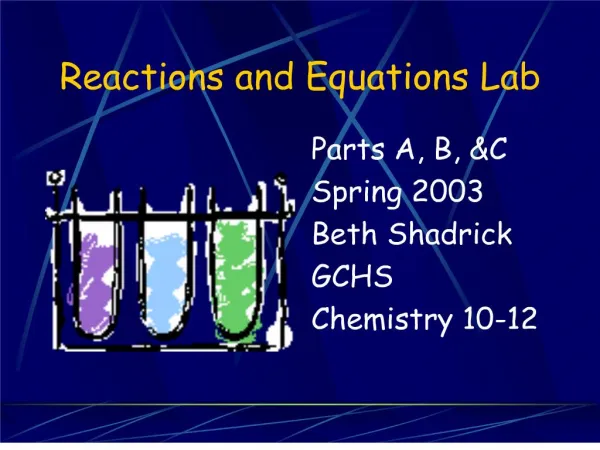
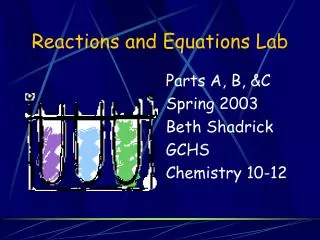
Reactions and Equations Lab Parts A, B, &C Spring 2003 Beth Shadrick GCHS Chemistry 10-12 Visit www.worldofteaching.com For 100’s of free powerpoints
Purpose • To observe 7 reactions • To identify and write formulas for the reactants and products of those reactions • To balance the equations for the reactions
Evidence of Chemical Reaction Part A R1 Mg ribbon is ash-like now R2 Litmus test indicates a base Part B R1 Solid turns white, steam comes from test tube R2 Solid turns blue again
Evidence of Chemical Reaction Part C R1 Fe nail is now coated in Cu and the solution has changed from a blue color to a greenish color
Evidence of Chemical Reaction Part C R2 Cu metal is now coated with Ag and the solution is beginning to take on a slightly blue tint
Evidence of Chemical Reaction Part C R3 HCl solution begins to vigorously bubble when the Mg ribbon is added. Gases are evident as they wisp through the air into the collecting tube; gas is flammable
Word Equations Part A • A1: Magnesium plus oxygen yields ? • A2: A1 product plus water yields ?
Word Equations Part B • B1: Copper (II) Sulfate Pentahydrate is heated to yield ? • B2 Anhydrous Copper (II) Sulfate plus water yields ?
Word Equations Part C • C1 Iron plus Copper (II) Sulfate yields… ? • C2 Copper plus Silver Nitrate yields… ? • C3 Magnesium plus Hydrochloric Acid yields… ?
Instructions • Complete the word equations by predicting the products, use the information you gathered by observation to help in the predictions • Be sure to include the state of the substance for the reactants and products • Classify the reaction
The End • Complete the equations for the reactions • Then you may go finish Part D of the lab instructions. You will need the solubility rules.