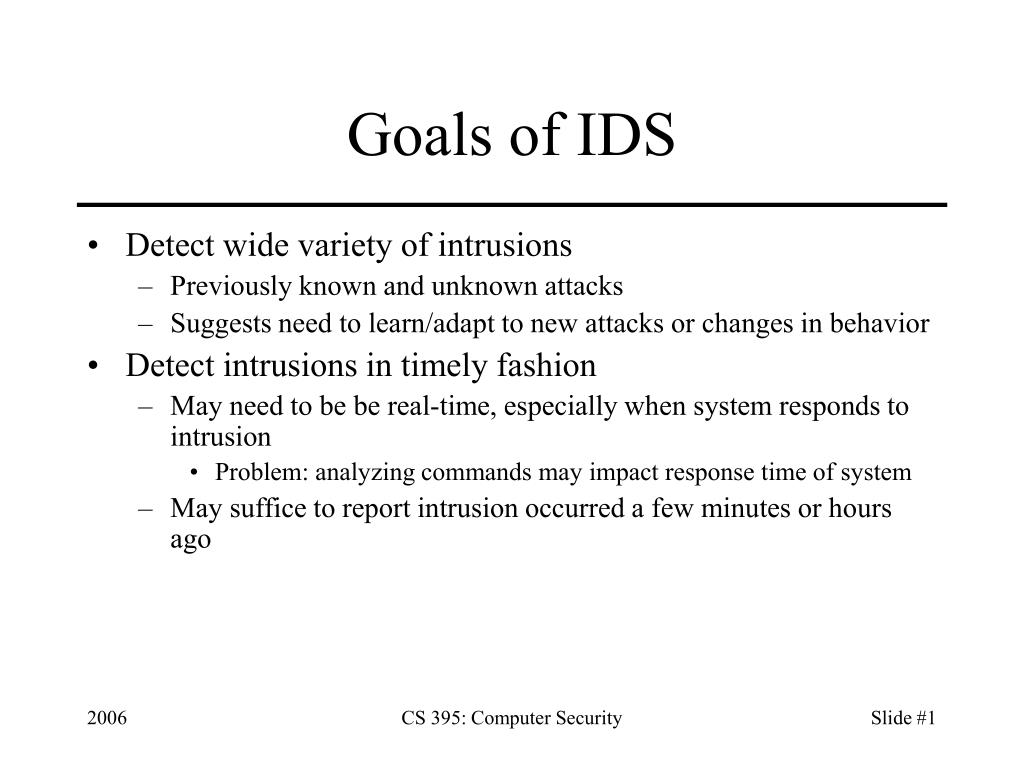
Goals of IDS. Detect wide variety of intrusions Previously known and unknown attacks Suggests need to learn/adapt to new attacks or changes in behavior Detect intrusions in timely fashion May need to be be real-time, especially when system responds to intrusion
Une image / un lien ci-dessous est fourni (tel quel) pour télécharger la présentation
Politique de téléchargement : le contenu du site vous est fourni TEL QUEL pour votre information et votre usage personnel ; il ne peut être vendu, concédé sous licence ni partagé sur d’autres sites sans l’accord de son auteur.Le contenu vous est fourni TEL QUEL, pour votre information et votre usage personnel uniquement.Téléchargez la présentation en cliquant sur ce lien.Lors du téléchargement, si vous ne parvenez pas à télécharger une présentation, l’éditeur a peut-être supprimé le fichier de son serveur.Pendant le téléchargement, si vous ne parvenez pas à obtenir une présentation, le fichier a peut-être été supprimé par l’éditeur.
F I N
Plus de contenu associé
Transcription de la présentation
Goals of IDS • Detect wide variety of intrusions • Previously known and unknown attacks • Suggests need to learn/adapt to new attacks or changes in behavior • Detect intrusions in timely fashion • May need to be be real-time, especially when system responds to intrusion • Problem: analyzing commands may impact response time of system • May suffice to report intrusion occurred a few minutes or hours ago CS 395: Computer Security
Goals of IDS • Present analysis in simple, easy-to-understand format • Ideally a binary indicator • Usually more complex, allowing analyst to examine suspected attack • User interface critical, especially when monitoring many systems • Be accurate • Minimize false positives, false negatives • Minimize time spent verifying attacks, looking for them CS 395: Computer Security
Models of Intrusion Detection • Anomaly detection • What is usual, is known • What is unusual, is bad • Misuse detection • What is bad is known • Specification-based detection • We know what is good • What is not good is bad CS 395: Computer Security
Anomaly Detection • Analyzes a set of characteristics of system, and compares their values with expected values; report when computed statistics do not match expected statistics • Threshold metrics • Statistical moments • Markov model CS 395: Computer Security
Threshold Metrics • Counts number of events that occur • Between m and n events (inclusive) expected to occur • If number falls outside this range, anomalous • Example • Windows: lock user out after k failed sequential login attempts. Range is (0, k–1). • k or more failed logins deemed anomalous CS 395: Computer Security
Difficulties • Appropriate threshold may depend on non-obvious factors • Typing skill of users • If keyboards are US keyboards, and most users are French, typing errors very common • Dvorak vs. non-Dvorak within the US CS 395: Computer Security
Statistical Moments • Analyzer computes standard deviation (first two moments), other measures of correlation (higher moments) • If measured values fall outside expected interval for particular moments, anomalous • Potential problem • Profile may evolve over time; solution is to weigh data appropriately or alter rules to take changes into account CS 395: Computer Security
Example: IDES • Developed at SRI International to test Denning’s model • Represent users, login session, other entities as ordered sequence of statistics <q0,j, …, qn,j> • qi,j (statistic i for day j) is count or time interval • Weighting favors recent behavior over past behavior • Ak,j is sum of counts making up metric of kth statistic on jth day • qk,l+1 = Ak,l+1 – Ak,l+ 2–rtqk,l where t is number of log entries/total time since start, r factor determined through experience CS 395: Computer Security
Example: Haystack • Let An be nth count or time interval statistic • Defines bounds TL and TU such that 90% of values for Ais lie between TL and TU • Haystack computes An+1 • Then checks that TL ≤ An+1 ≤ TU • If false, anomalous • Thresholds updated • Ai can change rapidly; as long as thresholds met, all is well • System is adaptive: as values of variables change, so do thresholds. CS 395: Computer Security
Potential Problems • Assumes behavior of processes and users can be modeled statistically • Ideal: matches a known distribution such as Gaussian or normal • Otherwise, must use techniques like clustering to determine moments, characteristics that show anomalies, etc. • Real-time computation a problem too CS 395: Computer Security
Markov Model • Past state affects current transition • Anomalies based upon sequences of events, and not on occurrence of single event • Events preceding time have put system into particular state • When next event occurs, system transitions into new state • Over time, transition probabilities are developed • When an event occurs that causes a transition with low probability, event is deemed anomalous CS 395: Computer Security
Markov Model • Problem: need to train system to establish valid sequences • Use known, training data that is not anomalous • The more training data, the better the model • Training data should cover all possible normal uses of system • Approach heralded misuse detection, and was used to develop effective anomaly detection mechanism CS 395: Computer Security
Example: TIM • Time-based Inductive Learning (AI technique) • System given type of event to be predicted. Develops set of temporally related conditions that predict time that event will occur with respect to the set • Ex. R:A B (p) • Says that B should follow A with probability p CS 395: Computer Security
Example: TIM • Sequence of events is abcdedeabcabc • TIM derives following rules: R1: abc (1.0) R2: cd (0.5) R3: ca (0.5) R4: de (1.0) R5: ea (0.5) R6: ed (0.5) • Seen: abd; triggers alert • c always follows ab in rule set • Seen: acf; no alert as multiple events can follow c • May add rule R7: cf (0.33); adjust R2, R3 CS 395: Computer Security
Sequences of System Calls • Forrest: define normal behavior in terms of sequences of system calls (traces) • Experiments show it distinguishes sendmail and lpd from other programs • Training trace is: open read write open mmap write fchmod close • Produces following database: (assuming trace length is 4) CS 395: Computer Security
Traces open read write open open mmap write fchmod read write open mmap write open mmap write write fchmod close mmap write fchmod close fchmod close close • Trace seen during non-training) is: open read read open mmap write fchmod close CS 395: Computer Security
Analysis • Differs in 5 places: • Second read should be write (first open line) • Second read should be write (read line) • Second open should be write (read line) • mmap should be write (read line) • write should be mmap (read line) • 18 possible places of difference • Mismatch rate 5/18 28% CS 395: Computer Security
Derivation of Statistics • IDES assumes Gaussian distribution of events • Experience indicates not right distribution • Clustering • Does not assume a priori distribution of data • Obtain data, group into subsets (clusters) based on some property (feature) • Analyze the clusters, not individual data points • Greatly reduces amount of data analyzed, at cost of increased preprocessing time to cluster data • Sensitive to features and statistical definitions of clustering CS 395: Computer Security
Example: Clustering proc user value percent clus#1 clus#2 p1 matt 359 100% 4 2 p2 holly 10 3% 1 1 p3 heidi 263 73% 3 2 p4 steven 68 19% 1 1 p5 david 133 37% 2 1 p6 mike 195 54% 3 2 • Clus#1: break into 4 groups (25% each); 2, 4 may be anomalous (1 entry each) • Clus#2: break into 2 groups (50% each) CS 395: Computer Security
Finding Features • Which features best show anomalies? • CPU use may not, but I/O use may • Use training data • Anomalous data marked • Feature selection program picks features, clusters that best reflects anomalous data CS 395: Computer Security
Example • Analysis of network traffic for features enabling classification as anomalous • 7 features • Index number • Length of time of connection • Packet count from source to destination • Packet count from destination to source • Number of data bytes from source to destination • Number of data bytes from destination to source • Expert system warning of how likely an attack CS 395: Computer Security
Feature Selection • 3 types of algorithms used to select best feature set • Backwards sequential search: assume full set, delete features until error rate minimized • Best: all features except index (error rate 0.011%) • Beam search: order possible clusters from best to worst, then search from best • As new potential clusters generated, they are added to list • Produced same same error rate and feature set size as backwards sequential search. CS 395: Computer Security
Feature Selection • 3 types of algorithms used to select best feature set • Random sequential search: begin with random feature set, add and delete features • Slowest • Produced same results as other two CS 395: Computer Security
Results • If following features used: • Length of time of connection • Number of packets from destination • Number of data bytes from source classification error less than 0.02% • Identifying type of connection (like SMTP) • Best feature set omitted index, number of data bytes from destination (error rate 0.007%) • Other types of connections done similarly, but used different sets CS 395: Computer Security
Misuse Modeling • Determines whether a sequence of instructions being executed is known to violate the site security policy • Descriptions of known or potential exploits grouped into rule sets • IDS matches data against rule sets; on success, potential attack found • Cannot detect attacks unknown to developers of rule sets • No rules to cover them • Sometimes even miss variations of known attacks CS 395: Computer Security
Example: IDIOT • Event: change in system state. Can be result of a single action, or a series of actions resulting in a single observable record • Five features of attacks: • Existence: attack creates file or other entity • Sequence: attack causes several events sequentially • Partial order: attack causes 2 or more sequences of events, and events form partial order under temporal relation • Duration: something exists for interval of time • Interval: events occur exactly n units of time apart CS 395: Computer Security
IDIOT Representation • Sequences of events may be interlaced • Use colored Petri nets to capture this • Each signature corresponds to a particular CPA • Nodes are tokens; edges, transitions • Final state of signature is compromised state • Example: mkdir attack • Edges protected by guards (expressions) • Tokens move from node to node as guards satisfied CS 395: Computer Security
IDIOT Features • New signatures can be added dynamically • Partially matched signatures need not be cleared and rematched • Ordering the CPAs allows you to order the checking for attack signatures • Useful when you want a priority ordering • Can order initial branches of CPA to find sequences known to occur often CS 395: Computer Security
Example: STAT • Analyzes state transitions • Need keep only data relevant to security • Example: look at process gaining root privileges; how did it get them? • Example: attack giving setuid to root shell ln target ./–s –s CS 395: Computer Security
State Transition Diagram • Now add postconditions for attack under the appropriate state CS 395: Computer Security
Final State Diagram • Conditions met when system enters states s1 and s2; USER is effective UID of process • Note final postcondition is USER is no longer effective UID; usually done with new EUID of 0 (root) but works with any EUID CS 395: Computer Security
USTAT • USTAT is prototype STAT system • Uses BSM to get system records • Preprocessor gets events of interest, maps them into USTAT’s internal representation • Failed system calls ignored as they do not change state • Inference engine determines when compromising transition occurs CS 395: Computer Security
How Inference Engine Works • Constructs series of state table entries corresponding to transitions • Example: rule base has single rule above • Initial table has 1 row, 2 columns (corresponding to s1 and s2) • Transition moves system into s1 • Engine adds second row, with “X” in first column as in state s1 • Transition moves system into s2 • Rule fires as in compromised transition • Does not clear row until conditions of that state false CS 395: Computer Security
Example: NFR (Network Flight Recorder) • Built to make adding new rules easily • Architecture: • Packet sucker: read packets from network • Decision engine: uses filters to extract information • Backend: write data generated by filters to disk • Query backend allows administrators to extract raw, postprocessed data from this file • Query backend is separate from NFR process CS 395: Computer Security
N-Code Language • Filters written in this language • Example: ignore all traffic not intended for 2 web servers: # list of my web servers my_web_servers = [ 10.237.100.189 10.237.55.93 ] ; # we assume all HTTP traffic is on port 80 filter watch tcp ( client, dport:80 ) { if (ip.dest != my_web_servers) return; # now process the packet; we just write out packet info record system.time, ip.src, ip.dest to www._list; } www_list = recorder(“log”) CS 395: Computer Security
Specification Modeling • Determines whether execution of sequence of instructions violates specification • Only need to check programs that alter protection state of system • System traces, or sequences of events t1, … ti, ti+1, …, are basis of this • Event ti occurs at time C(ti) • Events in a system trace are totally ordered CS 395: Computer Security
System Traces • Notion of subtrace (subsequence of a trace) allows you to handle threads of a process, process of a system • Notion of merge of traces U, V when trace U and trace V merged into single trace • Filter p maps trace T to subtrace T´ such that, for all events tiT´, p(ti) is true CS 395: Computer Security
Examples • Subject S composed of processes p, q, r, with traces Tp, Tq, Tr has Ts = TpTqTr • Filtering function: apply to system trace • On process, program, host, user as 4-tuple < ANY, emacs, ANY, bishop > lists events with program “emacs”, user “bishop” < ANY, ANY, nobhill, ANY > list events on host “nobhill” CS 395: Computer Security
Example: Apply to rdist • Ko, Levitt, Ruschitzka defined PE-grammar to describe accepted behavior of program • rdist creates temp file, copies contents into it, changes protection mask, owner of it, copies it into place • Attack: during copy, delete temp file and place symbolic link with same name as temp file • rdist changes mode, ownership to that of program CS 395: Computer Security
Relevant Parts of Spec 7. SE: <rdist> 8. <rdist> -> <valid_op> <rdist> |. 9. <valid_op> -> open_r_worldread … | chown { if !(Created(F) and M.newownerid = U) then violation(); fi; } … • END • Chown of symlink violates this rule as M.newownerid ≠ U (owner of file symlink points to is not owner of file rdist is distributing) CS 395: Computer Security
Comparison and Contrast • Misuse detection: if all policy rules known, easy to construct rulesets to detect violations • Usual case is that much of policy is unspecified, so rulesets describe attacks, and are not complete • Anomaly detection: detects unusual events, but these are not necessarily security problems • Specification-based vs. misuse: spec assumes if specifications followed, policy not violated; misuse assumes if policy as embodied in rulesets followed, policy not violated CS 395: Computer Security
IDS Architecture • Basically, a sophisticated audit system • Agent like logger; it gathers data for analysis • Director like analyzer; it analyzes data obtained from the agents according to its internal rules • Notifier obtains results from director, and takes some action • May simply notify security officer • May reconfigure agents, director to alter collection, analysis methods • May activate response mechanism CS 395: Computer Security
Agents • Obtains information and sends to director • May put information into another form • Preprocessing of records to extract relevant parts • May delete unneeded information • Director may request agent send other information CS 395: Computer Security
Example • IDS uses failed login attempts in its analysis • Agent scans login log every 5 minutes, sends director for each new login attempt: • Time of failed login • Account name and entered password • Director requests all records of login (failed or not) for particular user • Suspecting a brute-force cracking attempt CS 395: Computer Security
Host-Based Agent • Obtain information from logs • May use many logs as sources • May be security-related or not • May be virtual logs if agent is part of the kernel • Very non-portable • Agent generates its information • Scans information needed by IDS, turns it into equivalent of log record • Typically, check policy; may be very complex CS 395: Computer Security
Network-Based Agents • Detects network-oriented attacks • Denial of service attack introduced by flooding a network • Monitor traffic for a large number of hosts • Examine the contents of the traffic itself • Agent must have same view of traffic as destination • TTL tricks, fragmentation may obscure this • End-to-end encryption defeats content monitoring • Not traffic analysis, though CS 395: Computer Security
Network Issues • Network architecture dictates agent placement • Ethernet or broadcast medium: one agent per subnet • Point-to-point medium: one agent per connection, or agent at distribution/routing point • Focus is usually on intruders entering network • If few entry points, place network agents behind them • Does not help if inside attacks to be monitored CS 395: Computer Security
Aggregation of Information • Agents produce information at multiple layers of abstraction • Application-monitoring agents provide one view (usually one line) of an event • System-monitoring agents provide a different view (usually many lines) of an event • Network-monitoring agents provide yet another view (involving many network packets) of an event CS 395: Computer Security
Connexion au compte
Connectez-vous pour publier votre contenu sur SlideServe.