HEAT
This guide covers the essentials of temperature conversion between Fahrenheit, Celsius, and Kelvin, providing formulas and steps for accurate calculations. Users will learn how to solve 2-step temperature equations, such as converting Kelvin to Fahrenheit and vice versa. Additionally, the guide introduces heat units, including joules, calories, and British thermal units (Btus), explaining their historical context and relationships. By mastering these concepts, students can effectively navigate both theoretical and practical applications of thermal science.

HEAT
E N D
Presentation Transcript
HEAT ConversionTemperatures:
Temperature Scales • Fahrenheit • Celsius • Kelvin
Helpful Hints • Identify the equation needed. • Plug in the numbers to solve • Remember the math rules: • Solve what is in parenthesis first • Solve Multiplication & Division before addition and subtraction • Show all work • Put box around final answer
Solving 2–Step temperature equations • Necessary only when converting: • K to oF • oF to K
Temperature Conversion Equations • 4 equations to use: • oF = 9/5oC + 32 • oC = 5/9 (oF-32) • K = oC + 273 • oC = K – 273
Convert 500 K to ____ o F • First convert K to o C • Use this equation: oC = K – 273 • Then convert C to o F • Use this equation: oF = 9/5oC + 32
Step 1: oC = K – 273 oC = 500 – 273 oC = 227 Step 2: oF = 9/5oC + 32 oF = 9/5(227) + 32 oF = 1.8(227)+ 32 oF = 408.6+ 32 oF = 440.60 Convert 500 K to ____ o F
Convert 70 o F to ____ K • First convert o F to o C • Use this equation: oC = 5/9 (oF-32) • Then convert C to K • Use this equation: K = oC + 273
Convert 70 o F to ____ K • Step 1: oC = 5/9 (oF-32) oC = 5/9 (o70-32) oC = 0.55 (38) oC = 2.11 Step 2: K = oC + 273 K = 2.11 + 273 K = 275.11
Units of Heat Objectives are to: • define and distinguish between various units of heat • define the mechanical equivalent of heat • discuss everyday examples to illustrate these concepts Temperature Conversions:
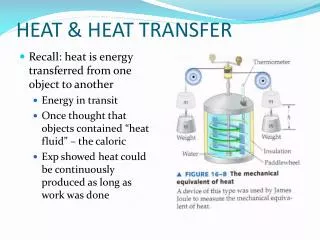
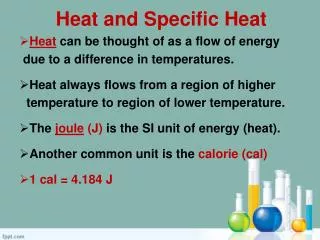
Units of Heat • Heat is energy in transit, and is measured in energy units. • The SI unit is the joule (J), or Newton-metre (Nm). • Historically, heat was measured in terms of the ability to raise the temperature of water. • The kilocalorie (kcal), or Calorie (Cal), or “big calorie”: amount of heat needed to raise the temperature of 1 kilogramme of water by 1 C0 (from 14.50C to 15.50C) • The calorie, or “little calorie”: amount of heat needed to raise the temperature of 1 gramme of water by 1 C0 (from 14.50C to 15.50C) • In industry, the British thermal unit (Btu) is still used: amount of heat needed to raise the temperature of 1 lb of water by 1 F0 (from 630F to 640F)
Mechanical Equivalent of Heat Joule demonstrated that water can be heated by doing (mechanical) work, and showed that for every 4186 J of work done, the temperature of water rose by 1C0 per kg.
Mechanical Equivalent of Heat • Conversion between different units of heat: 1 cal = 10-3 kcal = 3.969 x 10⁻³ Btu = 4.186 J 1 Cal = 1 kcal=4186 J
Sensible Heat Objectives are to: • describe what is meant by 'sensible heat‘ • define specific heat • explain how the specific heat capacities of materials are obtained using calorimetry
Specific Heat Capacity • Sensible heat is associated with a temperature change (can be “sensed”) • Different substances have different molecular configurations and bonding temperature change not generally the same for equal amounts of heat • Specific heat capacity, c: amount of energy needed to raise the temperature of 1 kg of a substance by 1K
Latent Heat Objectives are to: • Describe what is meant by ‘latent heat‘ • Compare and contrast the 3 phases of matter • Relate latent heat to phase changes
Phases of Matter • Heat required for phase changes: • Vaporization: liquid vapour • Melting: liquid solid • Sublimation: solid vapour • Heat released by phase changes: • Condensation: vapour liquid • Fusion: liquid solid • Deposition: vapour solid
Phase Diagrams • Visual representation of phase changes • Triple point: point at which all three phases coexist • Curves branching out from this point separate phase regions: • Fusion curve: solid-liquid boundary • Vaporization curve: liquid-gas boundary • Sublimation curve: solid-gas boundary
Methods of Heat Transfer Objectives are to: • describe the three methods of heat transfer • Give practical/environmental examples of each
Radiation • Heat transfer by electromagnetic waves • Does not need a material medium • Black body: perfect absorber perfect emitter (at all wavelengths)