Understanding Exponents: Base and Negative Powers Explained
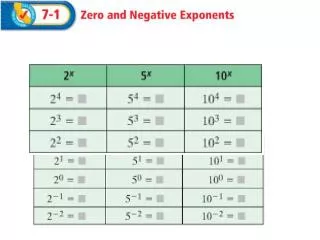
This guide explores the concept of exponents, focusing on how the exponent indicates how many times a base is used as a factor. For example, the calculation of 5^3 equals 5 × 5 × 5, resulting in 125. It discusses the rules surrounding negative exponents and the power of zero, clarifying that any number to the power of zero is 1 (x^0 = 1). The document also illustrates negative powers and their implications, using examples like x^-3 = 1/x^3 and how transformations of expressions can affect their values.

Understanding Exponents: Base and Negative Powers Explained
E N D
Presentation Transcript
Exponents Base 53 the factor of an exponent Exponent 53 determines how many times a “base” is used as a factor 53---meaning = 5•5•5 ---value = 125 5 = 51 (Any base without an exponent has a power of 1)
Negative Powers and the power of “0” x0 = 1 (any number to the power of “0” equals 1) 1 x-3 1 x = x3 x-1 = 1 4-3 1 43 = 43 4-3 = 5 x3 1 53x3 (5x)-3 = 5x-3 =