
Impact of Grandparental Child Rearing on Cognitive Development in Thai Infants
E N D
Presentation Transcript
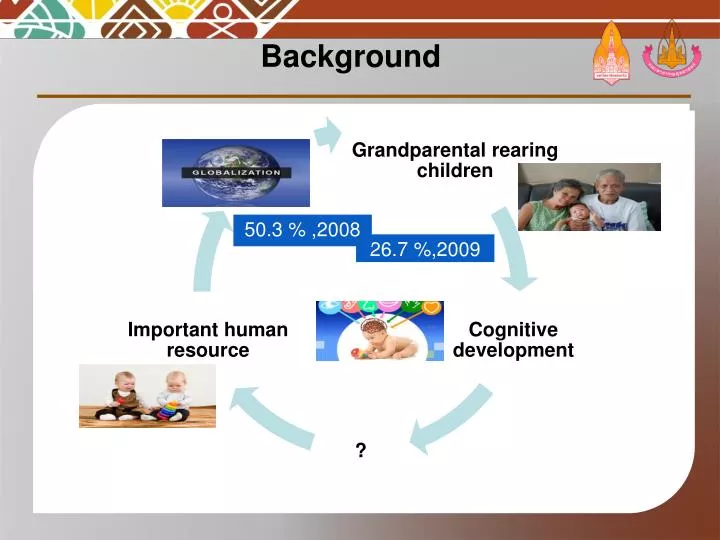
Background 50.3 % ,2008 26.7 %,2009
Background(cont.) -In children most studies of styles and factors related to child rearing. -Few studies on the child development and dimensions of child rearing on the cognitive development.
Objective of the study Aim 1: Study children’s cognitive developmental quotient among 12-month-old Thai infants Aim 2: Study effect of grandparental child rearing on the cognitive development among 12-month-old Thai infants.
Methodology • Population and sample • - The samples that all of members there are 4,225 infants • -Exclusion criteria were pregnant woman who were abortion and could not • communicate. There were 4,221 live birth, 32 deaths after within 1 year and • 11 withdrawers. So total sample were 4,116 from 5 areas • -The PCTC project was approved by the Nation Ethics Committee of the • Ministry of Public Health on 22 September 2000.
Methodology(cont.) • Study design • - This study is part of the prospective cohort study of Thailand(PCTC) • -Collected via interviews or extracted from existing records. • -Cognitive development was measuredby pediatriciansusing Capute scale(Bayley, N., 1993) • -Interest factor was grandparental child rearing • -Primary outcome was cognitive developmental quotient • -Secondary outcome was effect of grandparental child rearing on the • cognitive development • Statistical analysis • -Using Stata version 12 • - Using mean and standard deviation for continuous variable • and frequency and percentage for categorical variable • -95% confidence (CI) • -Logistic regression
RESULTS Children's Demographic Characteristics of children
RESULTS Demographic Characteristics of Caregiver
RESULTS(cont.) Demographic dimensions of child rearing Responsiveness Yes No
RESULTS(cont.) Demographic dimensions of child rearing
RESULTS(cont.) Aim:1 Cognitive developmental quotient
RESULTS(cont.) Aim:2 Effect of grandparental child rearing on cognitive development
RESULTS(cont.) Factors effecting on children’s cognitive development adjusted for all other factors
Discussion Aim:2 Grandparental child rearing effecting on the children’s cognitive development -Children who reared bygrandparents had 1.4 times chance of being delayed cognitive development than those reared by parents congruent with the studies by Nanthamongkolchai et.al,2009 and Nanthamongkolchai et.al,2011 -While gathering analyzed with child, caregiver and dimensions of child rearing variants by stepwise logistic regression pointed out that the child reared by grandparent not significantly -That is because Child rearing is a dynamic and has a bi-directional So the factors that influence the complex processes associated with child rearing (Berns,1993)
Strengths and Limitation the wealth of prospective, longitudinal • Strengths • -The evidence that was based on the largest cohort study of Thai children • -Followed 4,245 infants from birth in October 2000 to September 2002 • until three years old • -Deep investigated to dimensions of child rearing • Limitation • -Should be recognized. Confounding bias from other factors such as • experience of child rearing, health status and substance abuse of • caregiver
Conclusion and Recommendations • Conclusion • Child rearing by grandparents was at substantial risk for delay of cognitive • development when combined with other factors to promote. • Recommendations • - Health officials in the area should encourage the integration of caregiver the wealth of prospective, longitudinal to exchange experience and knowledge of child rearing; emphasized caregiver to hug or kiss, compliment and happy smiling or clapping with children -State and relevant agencies should propose a policy in promoting the cognitive development of children since was subjected in the womb maternal and should systematically and continuously intervention in the family have children cognitive developmental delayed.