Understanding Queues: FIFO Data Structure, Operations, and Implementations
This guide delves into the fundamentals of queues, a first-in, first-out (FIFO) data structure commonly used in various applications. We explore key operations such as enqueue (to add an object), dequeue (to remove an object), and methods to check size and emptiness. The differences between array and linked list implementations are discussed, along with their respective advantages and disadvantages. Additionally, practical examples and exercises, including implementing a queue using two stacks, provide a comprehensive overview of queue functionalities and their underlying algorithms.

Understanding Queues: FIFO Data Structure, Operations, and Implementations
E N D
Presentation Transcript
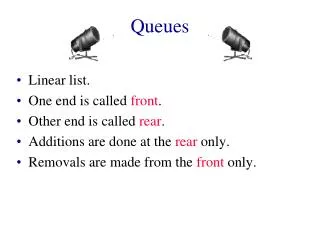
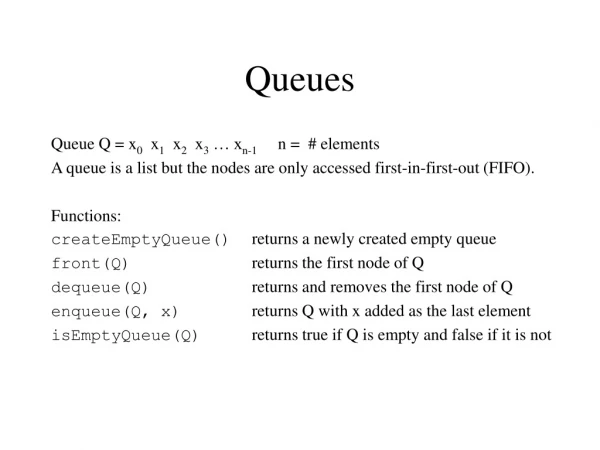
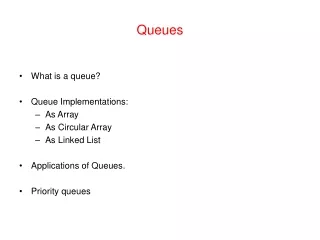
What is a queue? • First-in first-out data structure (FIFO) • New objects are placed at rear • Removal restricted to front • Examples?
Queue ADT Operations • enqueue(o): Insert o at rear of queue • Input: Object; Output: None • dequeue(): Remove object at front; error if empty • Input: None; Output: Object removed • size(): Return number of objects in queue • Input: None; Output: Integer • isEmpty(): Return a boolean indicating queue empty • Input: None; Output: Boolean • first(): Return object at front without removing; error if empty • Input: None; Output: Object
enqueue(5) enqueue(3) dequeue() enqueue(7) dequeue() front() dequeue() dequeue() isEmpty() enqueue(9) enqueue(7) size() enqueue(3) enqueue(5) dequeue() Example
Queue Interface int size() const; bool isEmpty() const; Object& front() throw (QueueEmptyException); void enqueue(const Object& obj); Object dequeue() throw(QueueEmptyException);
Underlying Representation • Array versus Linked List • Pros and cons? • Running time? • size • isEmpty • enqueue • dequeue • front
Array Implementation 0 1 2 3 4 5 6 … n-1 enqueue(5) enqueue(3) 5 3 0 1 2 3 4 5 6 … n-1 dequeue() ?
Array Implementation 0 1 2 3 4 5 6 … n-1 enqueue(5) enqueue(3) 5 3 0 1 2 3 4 5 6 … n-1 3 dequeue() ? 0 1 2 3 4 5 6 … n-1
Circular Array f r • f – stores index of cell which stores first element of queue • r – stores index of next available cell in queue • Initially, f = r = 0 • How do you add a new element? • How do you remove an element? 0 1 2 3 4 5 6 … n-1
Circular Array f r • How do you add a new element? • insert at array[r] • increment r • How do you remove an element? • return array[f] • increment f • What happens when r >= n-1? 0 1 2 3 4 5 6 … n-1
Circular Array r f • Need to be able to wrap around • Modulo – % • increment f using (f+1)%n • increment r using (r+1)%n 0 1 2 3 4 5 6 … n-1
Circular Array f r f dequeue 0 1 2 0 1 2 f r r f r =(2+1)%3= 0 enqueue enqueue 0 1 2 0 1 2 f r enqueue 0 1 2
Algorithms • size • return (N-f+r) mod N • isEmpty • return (f == r) • front • if isEmpty then throw QueueEmptyException • return array[f] • dequeue • if isEmpty then throw QueueEmptyException • temp = array[f] • f = (f+1)%N • return temp • enqueue • if size == N-1 then throw QueueFullException SIZE MUST BE < N-1 • array[r] = object • r = (r+1)%N
Linked List Implementation tail • enqueue • dequeue Ø head
Linked List Implementation new_node head tail • enqueue • if(size == 0) head = new_node • else tail->next_ptr = new_node • tail = new_node • increment size Object next_ptr
Linked List Implementation new_node head tail • enqueue • if(size == 0) head = new_node • else tail->next_ptr = new_node • tail = new_node • increment size Object1 Object2 next_ptr next_ptr
Linked List Implementation • dequeue • if (isEmpty) throw QueueEmptyException • head = head->next_ptr • decrement size • if new size is 0 – set tail to NULL
Exercises • Implement a queue using two stacks • Implement a two-color stack