Advancements in Confocal and Multiphoton Microscopy: Pioneering Techniques and Theories
This article explores the evolution and principles behind confocal and multiphoton microscopy, highlighting significant contributions from experts like Dr. Marvin Minsky and Dr. Maria Göppert-Mayer. We delve into the theory of two-photon absorption and emission, comparing conventional fluorescence methods with advanced laser scanning techniques. By examining the properties and applications of pulsed lasers at various wavelengths, we discuss their impact on cellular imaging and the intricacies of T-cell priming research. This comprehensive overview emphasizes the technological advancements that revolutionized in vivo imaging.

Advancements in Confocal and Multiphoton Microscopy: Pioneering Techniques and Theories
E N D
Presentation Transcript
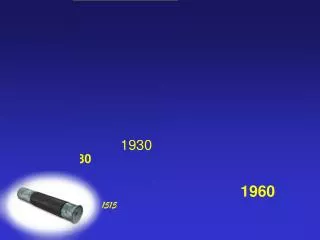
1930 1680 1960 1515
Confocal theory Dr. Marvin Minsky Confocal microscope: 1957
Laser Scanning Confocal Microscope LASER Light Amplification by the Stimulated Emission of Radiation
Dichroic Mirror
Fluorescence 400 nm
Wavelength and Light Properties (l) 575 nm High Energy Low Energy E = h c /l 0,5* *2
800 nm 800 nm 1200 nm 1200 nm 1200 nm Multiphoton exitation 400 nm Dr. Maria Göppert-Mayer : theory of two-photon quantum transitions (two-photon absorption and emission) 1931,
nm nm 500 800 1200 Temporal photon concentration Pulsed LASER LASER 500 nm 1000 nm 1200 nm 800 nm
Prof. Watt W. Webb et al. Two-photon laser scanning fluorescence microscopy: 1990 Spatial photon concentration
Photoconversion Excitation area Luo at al. Cell Structure and Function 2006, 31: 63 Comparison of photoactivation of PA-GFP in vivo with single-photon (405 nm) and multiphoton (790 nm) laser light.
In VIVO Imaging Thorsten at al. Nature 2004; 427: 159 T-cell priming by dendriticcells in lymph nodes occurs in three distinct phases