Download
1 / 53
530 likes | 657 Vues
This educational resource covers essential concepts related to chemistry, cells, and tissues. It includes a variety of questions and answers seeking to enhance understanding of human anatomy and physiological processes. Topics include metabolism, anatomical planes, tissue types, and chemical properties. Ideal for students in introductory biology or health science courses, each section delves into the fundamental principles that govern body functions: from basic chemistry elements to the organization's cellular makeup and tissue classification.

E N D
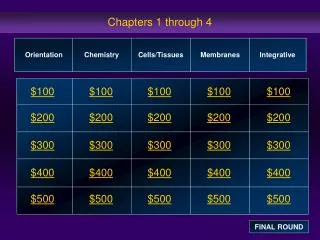
Chapters 1 through 4 Orientation Chemistry Cells/Tissues Membranes Integrative $100 $100 $100 $100 $100 $200 $200 $200 $200 $200 $300 $300 $300 $300 $300 $400 $400 $400 $400 $400 $500 $500 $500 $500 $500 FINAL ROUND
Orientation$100 Question • All chemical reactions that occur in the body are grouped under • a. histology • b. endocrinology • c. metabolism • d. cytology ANSWER BACK TO GAME
Orientation$100 Answer • All chemical reactions that occur in the body are grouped under • a. histology • b. endocrinology • c. metabolism • d. cytology BACK TO GAME
Orientation$200 Question • The popliteal surface is the • a. skull. • b. back of the knee. • c. front of the knee. • d. back of the heel. ANSWER BACK TO GAME
Orientation$200 Answer • The popliteal surface is the • a. skull. • b. back of the knee. • c. front of the knee. • d. back of the heel. BACK TO GAME
Orientation$300 Question • A sagittal plane cuts one into • a. anterior and posterior portions. • b. right and left portions. • c. equal right and left portions. • d. superior and inferior portions. ANSWER BACK TO GAME
Orientation$300 Answer • A sagittal plane cuts one into • a. anterior and posterior portions. • b. right and left portions. • c. equal right and left portions. • d. superior and inferior portions. BACK TO GAME
Orientation$400 Question • The region that includes most of the ribs is • a. the epigastric region. • b. the hypochondriac region. • c. the lumbar region. • d. the iliac region. ANSWER BACK TO GAME
Orientation$400 Answer • The region that includes most of the ribs is • a. the epigastric region. • b. the hypochondriac region. • c. the lumbar region. • d. the iliac region. BACK TO GAME
Orientation$500 Question • The space between the lungs and the inner lining of the thorax • a. pleural • b. pulmonary • c. peritoneum • d. mesentery ANSWER BACK TO GAME
Orientation$500 Answer • The space between the lungs and the inner lining of the lungs • a. pleural • b. pulmonary • c. peritoneum • d. mesentery BACK TO GAME
Chemistry$100 Question • If an element has an atomic number of 9 and an atomic mass of 19, how many neutrons does it have? • a. 9 • b. 10 • c. 19 • d. 28 ANSWER BACK TO GAME
Chemistry$100 Answer • If an element has an atomic number of 9 and an atomic mass of 19, how many neutrons does it have? • a. 9 • b. 10 • c. 19 • d. 28 BACK TO GAME
Chemistry$200 Question • If an atom gains electrons, it is called a (an) • a. ion • b. anion • c. cation • d. isotope ANSWER BACK TO GAME
Chemistry$200 Answer • If an atom gains electrons, it is called a (an) • a. ion • b. anion • c. cation • d. isotope BACK TO GAME
Chemistry$300 Question • A pH of 2 is • a. acidic • b. basic • c. neutral • d. strongly acidic ANSWER BACK TO GAME
Chemistry$300 Answer • A pH of 2 is • a. acidic • b. basic • c. neutral • d. strongly acidic BACK TO GAME
Chemistry$400 Question • Electrons are shared equally in this type of bond. • a. hydrogen • b. ionic • c. polar covalent • d. nonpolar covalent ANSWER BACK TO GAME
Chemistry$400 Answer • Electrons are shared equally in this type of bond. • a. hydrogen • b. ionic • c. polar covalent • d. nonpolar covalent BACK TO GAME
Chemistry$500 Question • NaOH + HCl yields NaCl + HOH is an example of this kind of a reaction. • a. synthesis • b. decomposition • c. exchange • d. anabolic ANSWER BACK TO GAME
Chemistry$500 Answer • NaOH + HCl yields NaCl + HOH is an example of this kind of a reaction. • a. synthesis • b. decomposition • c. exchange • d. anabolic BACK TO GAME
Cells/Tissues$100 Question • This organelle is responsible for protein synthesis. • a. mitochondria • b. lysosome • c. ribosome • d. Golgi apparatus ANSWER BACK TO GAME
Cells/Tissues$100 Answer • This organelle is responsible for protein synthesis. • a. mitochondria • b. lysosome • c. ribosome • d. Golgi apparatus BACK TO GAME
Cells/Tissues$200 Question • Long projections formed by centrioles that aid the cell in movement are called • a. microvilli. • b. centromeres. • c. cilia. • d. flagella. ANSWER BACK TO GAME
Cells/Tissues$200 Answer • Long projections formed by centrioles that aid the cell in movement are called • a. microvilli. • b. centromeres. • c. cilia. • d. flagella. BACK TO GAME
Cells/Tissues$300 Question • The nitrogenous bases found in RNA are • a. A, G • b. T, C • c. A, T, G, C • d. A, U, G, C ANSWER BACK TO GAME
Cells/Tissues$300 Answer • The nitrogenous bases found in RNA are • a. A, G • b. T, C • c. A, T, G, C • d. A, U, G, C BACK TO GAME
Cells/Tissues$400 Question • Which is a tissue in which all cells are flat and touch the basement membrane? • a. Simple cuboidal • b. Simple squamous • c. Stratified squamous • d. Transitional ANSWER BACK TO GAME
Cells/Tissues$400 Answer • Which is a tissue in which all cells are flat and touch the basement membrane? • a. Simple cuboidal • b. Simple squamous • c. Stratified squamous • d. Transitional BACK TO GAME
Cells/Tissues$500 Question • A tissue with lacunae is called • a. cartilage. • b. bone. • c. adipose. • d. both cartilage and bone. ANSWER BACK TO GAME
Cells/Tissues$500 Answer • A tissue with lacunae is called • a. cartilage. • b. bone. • c. adipose. • d. both cartilage and bone. BACK TO GAME
Membranes$100 Question • Which is the membrane lining the inside of the thoracic cavity? • a. peritoneum • b. pleural • c. pericardial • d. integumentary ANSWER BACK TO GAME
Membranes$100 Answer • Which is the membrane lining the inside of the thoracic cavity? • a. peritoneum • b. pleural • c. pericardial • d. integumentary BACK TO GAME
Membranes$200 Question • These membranes line bursa and the fibrous capsules surrounding joints. • a. serous • b. peritoneal • c. pleural • d. synovial ANSWER BACK TO GAME
Membranes$200 Answer • These membranes line bursa and the fibrous capsules surrounding joints. • a. serous • b. peritoneal • c. pleural • d. synovial BACK TO GAME
Membranes$300 Question • Third degree burns involve • a. epidermis • b. dermis • c. epidermis and dermis • d. epidermis, dermis, and hypodermis ANSWER BACK TO GAME
Membranes$300 Answer • Third degree burns involve the • a. epidermis. • b. dermis. • c. epidermis and dermis. • d. epidermis, dermis, and hypodermis. BACK TO GAME
Membranes$400 Question • Which is a layer of the epidermis found only in thicker, hairless skin? • a. Stratum basale • b. Stratum spinosum • c. Stratum granulosum • d. Stratum lucidum ANSWER BACK TO GAME
Membranes$400 Answer • Which is a layer of the epidermis found only in thicker, hairless skin? • a. Stratum basale • b. Stratum spinosum • c. Stratum granulosum • d. Stratum lucidum BACK TO GAME
Membranes$500 Question • This type of gland is numerous and produces sweat: • a. eccrine • b. apocrine • c. holocrine • d. endocrine ANSWER BACK TO GAME
Membranes$500 Answer • This type of gland is numerous and produces sweat: • a. eccrine • b. apocrine • c. holocrine • d. endocrine BACK TO GAME
Integrative$100 Question • In the anatomical position the thumbs are in what position to the body? • a. proximal • b. distal • c. medial • d. lateral ANSWER BACK TO GAME
Integrative$100 Answer • In the anatomical position the thumbs are in what position to the body? • a. proximal • b. distal • c. medial • d. lateral BACK TO GAME
Integrative$200 Question • This system fights infection and maintains blood pressure. • a. endocrine • b. lymphatic • c. integumentary • d. urinary ANSWER BACK TO GAME
Integrative$200 Answer • This system fights infection and maintains blood pressure. • a. endocrine • b. lymphatic • c. integumentary • d. urinary BACK TO GAME
Integrative$300 Question • The sodium-potassium pump moves • a. Na+ in • b. Na+ out • c. K+ out • d. Both a and c ANSWER BACK TO GAME
Integrative$300 Answer • The sodium-potassium pump moves • a. Na+ in • b. Na+ out • c. K+ out • d. Both a and c BACK TO GAME
Integrative$400 Question • This connective tissue is “cobwebby” and protects and anchors body organs. • a. areolar • b. striated • c. dense irregular • d. adipose ANSWER BACK TO GAME
Integrative$400 Answer • This connective tissue is “cobwebby” and protects and anchors body organs. • a. areolar • b. striated • c. dense irregular • d. adipose BACK TO GAME
Integrative$500 Question • The least malignant and most common skin cancer • a. Malignant melanoma • b. Basal cell carcinoma • c. Squamous cell carcinoma • d. Cuboidal cell carcinoma ANSWER BACK TO GAME