Understanding Cumulative Causation and Increasing Returns in Knowledge Acquisition
This text explores the concept of cumulative causation, emphasizing how each increment of knowledge enhances existing techniques rather than diminishing their value. It highlights the nature of knowledge as a public good, with social returns often outweighing private returns. Using historical examples from Silicon Valley and urban economies, it illustrates how agglomeration effects contribute to innovation and skill acquisition, forming a virtuous circle. To escape poverty traps, it argues for the importance of establishing social infrastructure to support knowledge and skill development.

Understanding Cumulative Causation and Increasing Returns in Knowledge Acquisition
E N D
Presentation Transcript
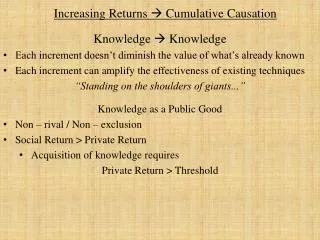
Increasing Returns Cumulative Causation Knowledge Knowledge Each increment doesn’t diminish the value of what’s already known Each increment can amplify the effectiveness of existing techniques “Standing on the shoulders of giants...” Knowledge as a Public Good Non – rival / Non – exclusion Social Return > Private Return Acquisition of knowledge requires Private Return > Threshold
Riding a Virtuous Circle—Development Returns to acquisition of knowledge and skills ...if it substitutes for what’s in place diminishing returns ...if it complements what’s in place increasing returns Evidence of increasing returns “Silicon Valley” Stanford Google Stanford “Wall Street” JP Morgan FRBNY JP Morgan-Chase “Sin City” Bellagio Cirque de Solei Wynn/Encore/Venetian/Palazzo • Agglomeration economies Urban rents • “Paradox” of factor flows Winner – Take – All: Rewards disproportionate to advantage
Riding a Virtuous CircleMatches and Leaks(Complements and Spillovers) • Production is social ... and so is consumption “You didn’t build it (alone)” It takes a village. Prerequisite institutional framework • Secure property rights/Law’n’ Order/The Usual Suspects.... Cooperating inputs • Skill supports skill: Doctors need nurses • Innovation begets innovation • Genius spurs genius Demonstration effects Knowledge spreads
Cumulative Causation: Stuck in a Trap Lack of social infrastructure • Low payoff to skill Little skill acquisition Lack of social infrastructure Lack of skills/means to employ knowledge Primary production Primitive techniques Stagnation Poverty Trap
Cumulative CausationEscaping the Trap Build social infrastructure • Subsidize/Tax consumption • Coordinate...industrial complex development...assure critical mass • “Great expectations” Self-fulfilling optimism Technology LEAPS • Creation without destruction...when there’s nothing to destroy Demography • Age and vested interest • Immigration: the future of the West Creation without destruction • Complementary inventions and technologies • Railroads and the steam engine/The internet and PCs Increasing Returns