
Understanding the Greeter Class in Java: Constructors and Instance Fields
This text explores the Greeter class in Java, emphasizing the concept of instance fields and constructors. Each object of the Greeter class has its own unique set of instance fields, which should be private to maintain encapsulation and data hiding. The class includes two constructors: one for a default instance and another that takes a string to set the instance field. An example is provided, demonstrating how to create and use Greeter objects in a test class to print personalized greetings. This highlights the importance of encapsulation and method overloading in OOP.

Understanding the Greeter Class in Java: Constructors and Instance Fields
E N D
Presentation Transcript
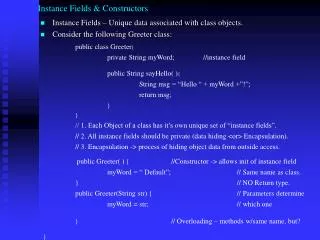
Instance Fields & Constructors public class Greeter{ private String myWord; //instance field public String sayHello( ){ String msg = “Hello “ + myWord+”!”; return msg; } } // 1. Each Object of a class has it’s own unique set of “instance fields”. // 2. All instance fields should be private (data hiding <or> Encapsulation). // 3. Encapsulation -> process of hiding object data from outside access. • Instance Fields – Unique data associated with class objects. • Consider the following Greeter class: public Greeter( ) { //Constructor -> allows init of instance field myWord = “ Default”; // Same name as class. } // NO Return type. public Greeter(String str) { // Parameters determine myWord = str; // which one }// Overloading – methods w/same name, but? }
Open BlueJ-> Type in the following: public class Greeter{ private String myWord; // instance field public Greeter(String str) { // Assignment constructor myWord = str; } public Greeter( ) { // Default constructor myWord = “”; } public String sayHello( ) {// method( ) return “Hello “ + myWord +”!”; } } Now open a new class and type in the following: public class GreeterTest{ public static void main(String[] args){ Greeter worldGreeter = new Greeter(“World”); Greeter daveGreeter = new Greeter(“Dave”); Greeter defaultGreeter= new Greeter( ); System.out.println(worldGreeter.sayHello()); System.out.println(daveGreeter.sayHello()); System.out.println(defaultGreeter.sayHello()); } }