Download

1 / 27
270 likes | 398 Vues
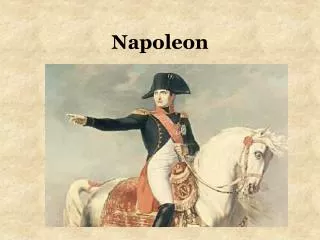
Napoleon Bonaparte, born into a poor Corsican noble family, transformed from a military academy student to the Emperor of France. His early military successes, including victories in Italy and turbulent expeditions like the invasion of Egypt, solidified his status. His governance reforms established the Napoleonic Code and modernized the French economy. However, costly wars, including the disastrous invasion of Russia, led to his downfall. After being exiled, he briefly returned to power before ultimate defeat at Waterloo. His legacy profoundly shaped Europe in the 19th century.

E N D
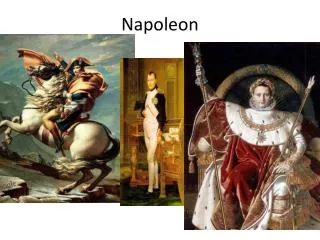
“A Man of Destiny” • Poor family of Lesser Nobility • Born in Corsica • 10 Yrs. Old - Military School • 1783 Student at military academy in Paris
Napoleon’s Marriages • 1st Wife – Josephine • March 9, 1796 Married • Divorced 1809 • 2nd Wife – Marie Louis • 17 Year Old Hapsburg Princess
Early Military Career • 1st Coalition • 1796 - Command of French Army in Italy • 1798 - Invaded Egypt • Discovery of Rosetta Stone • Military Set Back - still Hero
Early Military Career • 2nd Coalition – Russia formed new alliance with Great Britain. Austria, Portugal, Naples and the Ottoman Empire joined • France suffered defeats in Italy and Germany • Weakened Directory
Rise to Power • 1799 French wanted order • 1799 - Coup d’etat - Napoleon ousted the Directory • Consulate Formed • Napoleon = 1st Consul [power concentrated in the 1st Consul]
2nd Coalition Continues • 1800 defeated Austrians – dropped out 1801 • March 1802 – Treaty of Amiens • Truce w/ Great Britain • France kept European Conquests
Emperor Napoleon • 1802 Plebicite made him consul for life • 1804 Declared himself Hereditary emperor • 1805 Took title, King of Italy • Stepson ruled as viceroy • Divorced Josephine
Napoleon's Government Policies • Centralized Administration • Economic Reforms • Napoleonic Code • The Concordat of 1801 • Reforms in Education
Centralized AdministrationFinancial Reforms • System of Prefects and Subprefects • 83 Departments run by Prefects • Subprefects administered districts • Economic Corruption and waste was Eliminated • Centralized tax collecting system • Paid off various economic obligations • Stabilized French Economic condition
Napoleonic Code • 1800 appointed Commission to draft a new code of civil law • 1804 Went into effect and in 1807 it became the Napoleonic code • Progressive in some ways • Less Progressive in others
Napoleonic Wars • Third Coalition • Battle of Trafalgar • Victories in Europe • Continental System • The Peninsular War • The Invasion of Russia
3rd Coalition and Trafalgar • 1805 – 3rd Coalition Created for Balance of Power • 1805 – Napoleon prepared to invade G.B. • October 21 – Lord Nelson found combined French and Spanish fleet at Cape Trafalgar. • British victory – France lost all hope of ever winning a naval battle
Continental System and The Peninsular War • Continental System was an effort to destroy British economy • Ordered all European nations to stop trading w/ G.B. • All European ports closed to British ships • Impossible to enforce – 2 “leaks” • Portugal and Spain - refused • Russia – resumed trade after 1810 • Peninsular War (1808 – 1814) • Perhaps it was Napoleon’s Vietnam
Invasion of Russia - 1812 • Response to Russia resuming trade with Britain • Sent 600,000 Men in, and 100,000 survived • Scorched Earth Policy • Lack of Preparation for the winter • Marked the beginning of his fall
The Fall of Napoleon • 1813 – Russian, Prussian, and Austrians joined the most powerful coalition against Napoleon • Defeated at Leipzig – the Battle of Nations • 1814 – abdicated and was exiled to the Island of Elba • March 1815 – escaped and returned to power for 100 Days. • Defeated at Waterloo – June 1815 • Exiled to South Atlantic Island of St. Helena • Died 1821
Main Objectives • It’s job was to undo everything that Napoléon had done: • Reduce France to its old boundaries her frontiers were pushed back to 1790 level. • Restore as many of the old monarchies as possible that had lost their thrones during the Napoléonic era. • Supported the resolution: There is always an alternative to conflict.
Key Players at Vienna Foreign Minister, Viscount Castlereagh (Br.) Tsar Alexander I (Rus.) The “Host”Prince Klemens von Metternich (Aus.) King Frederick William III (Prus.) Foreign Minister, Charles Maurice de Tallyrand (Fr.)
Key Principles Established at Vienna • Balance of Power • Legitimacy • Compensation • Coalition forces would occupy France for 3-5 years. • France would have to pay an indemnity of 700,000,000 francs.
Changes Made at Vienna (1) • France was deprived of all territory conquered by Napoléon. • Russia was given most of Duchy of Warsaw (Poland). • Prussia was given half of Saxony, parts of Poland, and other German territories. • A Germanic Confederation of 30+ states (including Prussia) was created from the previous 300, under Austrian rule. • Austria was given back territory it had lost recently, plus more in Germany and Italy. • The House of Orange was given the Dutch Republic and the Austrian Netherlands to rule.
Changes Made at Vienna (2) • Norway and Sweden were joined. • The neutrality of Switzerland was guaranteed. • Hanover was enlarged, and made a kingdom. • Britain was given Cape Colony, South Africa, and various other colonies in Africa and Asia. • Sardinia was given Piedmont, Nice, Savoy, and Genoa. • The Bourbon Ferdinand I was restored in the Two Sicilies. • The Duchy of Parma was given to Marie Louise. • The slave trade was condemned (at British urging). • Freedom of navigation was guaranteed for many rivers.