Exploring Properties and Theorems of Parallelograms: Finding Variables and Side Lengths
In this lesson, we delve into the properties and theorems of parallelograms, focusing on identifying variable values and calculating side lengths. Key theorems, such as the congruence of opposite sides and angles, are examined. Students will practice finding the lengths of sides and values of variables using given expressions. We’ll review essential theorems like the diagonals bisecting each other and congruence of segments cut by parallel lines. Engage in exercises that enhance understanding and application of these geometric principles.

Exploring Properties and Theorems of Parallelograms: Finding Variables and Side Lengths
E N D
Presentation Transcript
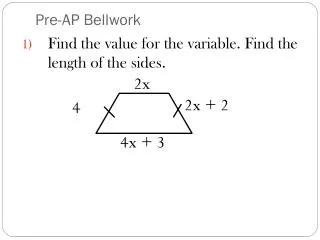
Pre-AP Bellwork • Find the value for the variable. Find the length of the sides. 2x 2x + 2 4 4x + 3
Theorems about parallelograms Theorem 6-1—Opposite sides of a parallelogram are congruent
Theorems about parallelograms Theorem 6-2— Opposite angles of a parallelogram are congruent *** Note- consecutive angles of a parallelogram are supplementary
Theorems about parallelograms Theorem 6-3—If a quadrilateral is a parallelogram, then its diagonals bisect each other. Q R P S
EX. Find the value of x and y of the parallelogram. Find AB, DC, A , D 3x - 15 B A (3y + 37)° (6y + 4)° D C 2x + 3
EX 2. Find the values of x & y of the given parallelogram. x + 1 2x y 3y-7
Theorem 6-4 A B If three (or more) parallel lines cut off congruent segments on one transversal, then they cut of congruent segments on every transversal. BD≅DF C D E F
EX. 3… BD = 8. Find DF and BF. A B C D E F