Understanding Triangle Congruence Using CPCTC, SSS, SAS, ASA, AAS, and HL Theorems
This guide explores the fundamental principles of triangle congruence through theorems such as SSS, SAS, ASA, AAS, and HL. By understanding how to use these theorems, you can demonstrate that triangles are congruent and make conclusions about their corresponding parts based on CPCTC (Corresponding Parts of Congruent Triangles are Congruent). This includes proving angles and sides congruent in various scenarios, including Isosceles Triangle Theorem and the Hypotenuse-Leg Theorem. Mastering these concepts is essential for solving geometric problems effectively.

Understanding Triangle Congruence Using CPCTC, SSS, SAS, ASA, AAS, and HL Theorems
E N D
Presentation Transcript
Using CPCTC and HL
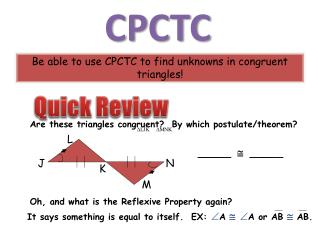
You know how to use three parts of triangles to show that the triangles are congruent… SSS SAS ASA AAS
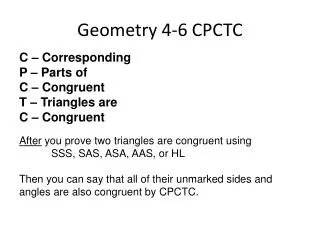
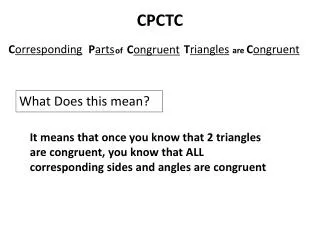
Once you have triangles congruent, you can make conclusions about their other parts because corresponding parts of congruent triangles are congruent. ABC DEF implies… A D, B E, C F AB DE, BC EF, AC DF
In other words….. CPCTC Congruent Congruent Triangles Parts Corresponding How is this useful?
O Given: MO RE ME OR R M Prove: M R E
A T Given: AT MR AT || MR Prove: A R M R
Let’s complete a flow proof. P Given: l AB l bisects AB at C P is on l Prove: PA = PB A B C l
REVIEW: Isosceles Triangle Theorem – If two sides of a triangle are congruent, then the angles opposite those sides are congruent.
REVIEW: Converse of Isosceles Triangle Theorem – If two angles of a triangle are congruent, then the sides opposite the angles are congruent. Can be referred to as the BASE ANGLE THEOREM.
Theorem: Hypotenuse-Leg Theorem (HL) – If the hypotenuse and a leg of one right triangle are congruent to the hypotenuse and a leg of another right triangle, then the triangles are congruent.
Given: HV GT GH TV I is the midpoint of HV G V I H Prove: IGH ITV T