New physics @ ATLAS
In this talk, Alan Barr from the University of Oxford addresses the challenges of electroweak symmetry breaking and the hierarchy problem, with a focus on weakly interacting massive particles (WIMPs). He explains the physics at the TeV scale and reviews the strategies used by ATLAS in searching for supersymmetry (SUSY) through various channels. Barr discusses kinematic variables, control regions, and the latest results from SUSY analyses, highlighting the importance of systematic uncertainties. His insights provide a comprehensive overview of recent developments in high-energy particle physics.

New physics @ ATLAS
E N D
Presentation Transcript
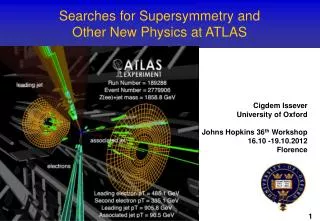
New physics @ ATLAS Alan Barr University of Oxford Kings College London 23rd March 2011
Electroweak symmetry breaking Hierarchy problem? WIMPs? What is the physics at the TeV-scale? Alan Barr, University of Oxford
End of 2010 run 22 July ICHEP Alan Barr, University of Oxford
Parton-parton luminosity Alan Barr, University of Oxford
SUSY & BSM strategy • Precision reliable hermetic detector • Basic kinematics • Understand detector and SM • Look at final states with: Examples given Lepton(s) Proton Jet(s) Photon(s) Proton Invisible(s) Alan Barr, University of Oxford
Basic kinematics Transverse momenta, pT Missing transverse momentum, ETmiss Pseudorapidity, η = - ln tan θ/2 Azimuthal angle differences Δφ Scalar sums of transverse momenta: HT, meff = HT + ETmiss Transverse mass mT = “Stransverse” mass (generalisation of mT to 2 parent particles) Alan Barr, University of Oxford
1-lepton SUSY 1-lepton + Jets + ETmiss Lepton reduces QCD BGExpect leptons in SUSY cascade decays 1 electron or muonpT>20 GeV 3 jetspT > {60, 30, 30} GeV ETmiss > 125 GeVETmiss > 0.25 * meff mT > 100 GeV meff> 500 GeV First ATLAS SUSY paperarXiv:1102.2357 accepted by PRL Selection based heavily on pre data-takingMC studies e.g. arXiv:0901.0512
1-lepton SUSY Control regions – some examples Multiple redundant control regions QCD background separately Systematics include (not only) JES, JER, lumi, lepton efficiency, CR stats, extrapolation, … Top C/R distinguished from W+jets using b-tagging Alan Barr, University of Oxford Great care with BG for all analyses presented
1-lepton SUSY 1-lepton results Likelihood ratio as a function of signal strength Toy MCs for p-values Profile likelihood for nuisance parameters (conservative systematics)Fully simulated backgrounds, signal pointsIncludes systematic uncertainties on signal strength Alan Barr, University of Oxford
0-lepton SUSY ArXiV:1102.5290 SUSY: Jets + ETmiss Conceptually simple search for squarks and gluinosSeveral overlapping signal regions: Squark decays Gluino decays Alan Barr, University of Oxford
0-lepton SUSY Robust background determinations • 2-4 measurement methods per background • Examples: • Reversal of cuts & kinematic control regions • Fully data-driven inc. jet transfer functions • Tau re-decay, smear • Z νν from:Z ee, Z μμW eν, W μν Alan Barr, University of Oxford
Squark, Gluino interpretations 0-lepton SUSY Exclude non-SM effective cross sections (σ x BR x Acc x Eff):A: 1.3 pb B: 0.35 pb C: 1.1 pb D: 0.11 pb https://atlas.web.cern.ch/Atlas/GROUPS/PHYSICS/PAPERS/susy-0lepton_01/ Alan Barr, University of Oxford
Multi-lepton SUSY Multi-lepton SUSY ≥ 3 leptons (electron or muon) Expect: Observe no events Top dominates after Z veto Also phenomenological limits: see… https://atlas.web.cern.ch/Atlas/GROUPS/PHYSICS/CONFNOTES/ATLAS-CONF-2011-039/ Alan Barr, University of Oxford
SUSY with b jets SUSY with b-jets Sensitive to Stop, Sbottom, Gluinoproduction Done for both 1-lepton, 0-lepton channels Top background dominates after b-jet requirementData-driven QCD background determination Paper in the pipeline… Alan Barr, University of Oxford
R-hadrons Stable charged particle search Two independent detector subsystems dE/dx: pixels (Time over threshold) β: tile (ToF resolution ≈ns) 95% confidence limits: Stable gluino > 586 GeV Stable stop > 309 GeV Stable sbottom 294 GeV Alan Barr, University of Oxford
W’ searches Electrons Muons Electron pT> 25 GeV, |η| < 1.37 or 1.52 < |η| < 2.40 MuonpT> 25 GeV, |η| < 1.05 ETmiss > 25 GeV M(W’SSM) > 1.49 TeV arxiv:1103.1391 Alan Barr, University of Oxford
Muons Electrons Z’ searches… M(Z’SSM) > 1.05 TeV Alan Barr, University of Oxford
Dijet inv. mass, angular distributions Compositeness scale, Λ > 9.6 TeV http://arxiv.org/abs/1103.3864 Alan Barr, University of Oxford
Diphoton resonances https://atlas.web.cern.ch/Atlas/GROUPS/PHYSICS/CONFNOTES/ATLAS-CONF-2011-044/ Alan Barr, University of Oxford
Diphoton + ETmiss Interpret in context of Universal Extra Dimensions ΛR = 20 Alan Barr, University of Oxford
Fourth generation Q search • Di-leptonic channel Approximate mass reconstruction on varying Δη,Δφ Excludes m(Q) < 270 GeV(@95% CL) Alan Barr, University of Oxford
Preliminary conclusions • Excellent operation of LHC and ATLAS • Commissioned physics objects:Jets, e, mu, ETmiss, photons, b-jets, (tau) • Wide variety of such final states studied • Also exotics… R-hadrons, multi-charged particles, stopped gluinos… • Many limits well beyond previous colliders
A few little Extras Alan Barr, University of Oxford
Papers and CONF notes 1/3:SUSY papers and notes https://twiki.cern.ch/twiki/bin/view/AtlasPublic/SupersymmetryPublicResults Alan Barr, University of Oxford
Papers and CONF notes 2/3:Exotics papers https://twiki.cern.ch/twiki/bin/view/AtlasPublic/ExoticsPublicResults Alan Barr, University of Oxford
Papers and CONF notes 3/3Exotics Conf notes https://twiki.cern.ch/twiki/bin/view/AtlasPublic/ExoticsPublicResults Alan Barr, University of Oxford
0-lepton SUSY Missing transverse momentum Alan Barr, University of Oxford
0-lepton SUSY meff distributions Cuts shown on mass-sensitive variable in final selection Alan Barr, University of Oxford
0-lepton SUSY BG example: ETmiss tails One example of very, very, very many background studies Alan Barr, University of Oxford
1-lepton SUSY Alan Barr, University of Oxford
arXiv:1102.2357 1-lepton SUSY 1-lepton + Jets + ETmiss Alan Barr, University of Oxford
1-lepton SUSY 1-lepton results Alan Barr, University of Oxford
Profile likelihood • Hatted quantities maximise likelihood • Double hatted quantities maximise L for given value of s • s and s-hat constrained to be non-negative • Likelihood ratio is the test statistic used to calculate the p-value Alan Barr, University of Oxford
1-lepton SUSY Kinematic distributions Electron channel Muon channel Alan Barr, University of Oxford
Di-photon + ETmiss • S arxiv:1012.4272 Alan Barr, University of Oxford
Multi-lepton SUSY Jets, Electrons, Muons, ETmiss • Charginos and neutralino cascade decays • ≥ 3 leptons (electron or muon)pT > {20, 20, 20(e) or 10 (mu)} GeV • ≥ 2 jets with pT > 50 GeVand |η| < 2.5 • ETmiss > 50 GeV • mll (ossf) Z mass veto (within 5 GeV of mZ) • mll (ossf) photon veto (< 20 GeV) SM: Observe no events Top dominates after Z veto Alan Barr, University of Oxford
SM: H→γγ ATLAS-CONF-2011-025 • Mass range: 110 GeV - 140 GeV • Data-driven estimation of all background components • γγ, γj, jj • Inclusive • only discriminant diphoton inv. mass Sensitivity close to the current Tevatron limits.
Z →ττ mu + had ATLAS-CONF-2011-010 ATLAS-CONF-2011-045 e + had e + mu
R-hadrons Stable massive particle search • Two independent detector subsystems • dE/dx: pixels(Time over threshold) • β: tile (ToF resolution ≈ns) • ETmiss > 40 GeV (trigger) • pT > 50 GeV http://arxiv.org/abs/1103.1984 Alan Barr, University of Oxford
0-lepton SUSY 0-lepton results Conservative systematics Jet energy scale (~7%) Luminosity (11%) Control region statistics Lepton veto Different MC b-jet fraction MC statisticsHigher orders… more … Alan Barr, University of Oxford
Di-lepton SUSY Dilepton SUSY Alan Barr, University of Oxford