Exploring Comet Activity and Composition: Unveiling the Mysteries of Dirty Snowballs
This seminar delves into the intricate processes governing comet activity and composition, particularly focusing on the sublimation of gases, dust escape dynamics, and the resultant development of comas and tails. Topics include the effects of solar radiation pressure, photodissociation, gravitational influences, and historical perspectives on comet observations. Additionally, it discusses the role of the Oort Cloud and the implications of non-gravitational forces on comet activity, providing insights into the origins and evolution of these celestial bodies.

Exploring Comet Activity and Composition: Unveiling the Mysteries of Dirty Snowballs
E N D
Presentation Transcript
Comet Activity and Composition K. Meech Ast 734 Seminar 8/30/04
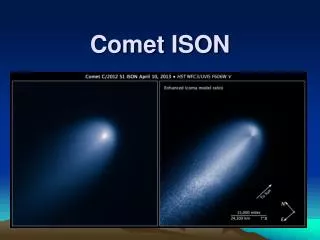
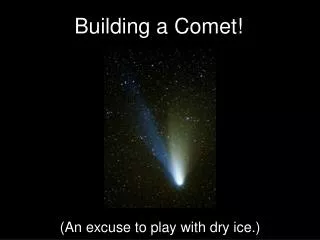
Inactivity to Activity • Sublimation of gases • Drags dust from nucleus • Gravity low • Most dust escapes • Solar radiation pressure coma tail • Photodissociation of gas • Ionization gas tail • Activity develops • Km-scale nucleus • Coma ~ 105 km • Tail ~ 106-107 km
Dust Coma Development 01/19/99 r=3.1AU 04/06/98 r=4.3 AU 07/15/99 r=2.2 AU q-620 dy; Afr = 14 cm q-350 dy; Afr = 31 cm q-150 dy; Afr = 105 cm 08/22/00 r=2.6 AU 09/30/00 r=2.8 AU 11/12/01 r=4.4 AU q+210 dy; Afr = 87 cm q+300 dy; Afr = 83 cm q+590 dy; Afr = 13 cm
Who Cares? “extragalactic student” “extragalactic astronomers observing a comet”
Cosmic Solar System History Earth in the Hadean Oceans & rocks form ~4.4 Gy ago >4.6 Gy ISM dark cloud Planetesimals condense Planets accrete Form few x100 million years Late planetary bombardment Comets, asteroids bring water & Organics to Earth The Archean Epoch Oldest life on Earth 3.5-3.8 Gy ago
The Oort Cloud • 17th century physics: Brahe, Kepler & Newton • Eorbit = -m/2a • Distribution of 1/aoriginal • 22 long-period comets • Strongly peaked • Source 50,000-150,000 AU • Contains 1011 comets • Width very narrow • Fading Problem • “Volatile Frosting” • Different chemistry Oort, J. (1950) B.A.N. 408, 91-110. Oort J. H. & M. Schmidt (1951) B.A.N. 419, 259-270
The Modern Oort Cloud • Outer Oort Cloud 15,000-105 AU • Stellar perturbations > 104 AU • Inner Oort Cloud 2000-15,000 • Galactic Tides • Dynamically inert 50-2000 AU • Kuiper Belt 35-50 AU • Stable, dynamically active • Classical, 3:2, scattered • Dynamically new • 1/aorig < 100x10-6 AU-1 • Long Period P > 200 yr • Short Period P < 200 yr • Halley family – Oort cloud origin • Jupiter family – KBO origin • Centaurs transition objects
The Evidence for Fading • Different types of evidence • Really bright comets are all long-period • Distant comets narrow tails (large dust) volatile gases • New comets tend to split more frequently (more volatiles) • Non-gravitational motion (jets) • Problems • Non uniform data sets • Non-linear detectors Great Comet 1577 Morehouse 1908 III Halley 1910 Delavan 1914
Evidence for Differences • Dots = All SP obs • Squares = Halley • Triangles = DN comet
Sublimation of Volatiles? • Delsemme’s original work: albedo too high • Water-activity out beyond Jupiter
Water Ice Physics • Phase I: P < 2700 atm • Ih – hexagonal • Ic – cubic (low T, low P phase) • High P forms: II to XIV • Amorphous Tcond< 100K • Traps gases • Clathrates • Mechanical trapping in cages
Comet Formation 100K 64K 31K 0 10 100 AU
Low Temperature Condensation • Ices in comets condensed T< 100K • Amorphous form • Trapped other gases • Amounts depend on r • Release of gases • 137K amorphous crystalline phase change • Annealing (30-35K) • Sublimation 160-180K CH4 N2 Ar CO • Gas release at large distances: controlled by Water
Heat Transfer in Comets • Conduction low • Depends on porosity (unknown) • Radiation • Gas phase conduction (recondensation) • Sintering • Changes the conductivity • Volatile re-distribution • Insulating layers
The Halley Outburst • Gas Laden amorphous ice model • Heat from perihelion penetrates to ice layer • Exothermic transformation (137K) • Released gases build up pressure outburst
Chiron’s Behavior • Amorphous ice model • 60% dust • 40% amorphous ice • 0.1% trapped CO • Matches observations • Density < 0.4 g/cm3 • Mass loss rates & dust • CO fluxes match obs • Tsurface matches obs • Activity sporadic not refreshing surface
Hale Bopp • Active at large r • Discovered 7.2 AU (1995) • Pre-discovery image 13.0 AU (1993) • Dynamically young • Large CO fluxes seen • Molecules of different volatilities appear at similar times
Thermal models: Comet Hale Bopp • Amorphous ice crystallization model • Porosity 0.65 • 4% by mass trapped CO
Activity at Larger r? • Distance for T ~ 137K • Beginning near 10 AU • Mechanisms at r > 10 AU • Solid volatiles (e.g. CO, CO2) sublimation • Annealing C/2003 A2 Gleason q = 11.43 AU 1/a = 42 x 10-6 AU-1
KBO1996 TO66 – Activity? • Orbit • Q = 48.6, q = 38.5 • q: 5/3/1910 Q: 2/1/2054 • Lightcurve period • 1997: 2 peak 6.25 +/- 0.03 hr, Dm = 0.12 mag • 1998: single peak, Dm = 0.33 • Consistent with activity • Blue colors • Vary with rotation in 1999
Observations • Subaru 8m + Suprime Cam • 8x12 K CCD mosaic • 0.2”/pixel, 0.25o FOV • Target Selection • 15 blue-neutral objects • Select smallest r = 33.8 AU • 1997QJ4: V-R = 0.296 (Plutino) • r = 33.8 AU, Hv=7.5 (rad = 80 km) • October 3, 4 2002 UT • Nt 1 phot, Nt 2 clouds • Sensitivity • S/N = 3, V=28 12000s
Composite Image • Single exp, 400 sec
Composite Image • Single exp, 400 sec • 12000s sum
Composite Image • Single exp, 400 sec • 12000s sum (zoomed 80”)
Composite Image • Single exp, 400 sec • 12000s sum (zoomed 80”) • Median combined
Composite Image • Single exp, 400 sec • 12000s sum (zoomed 80”) • Median combined • Shift & sum for KBO rate
Composite Image • Single exp, 400 sec • 12000s sum (zoomed 80”) • Median combined • Shift & sum for KBO rate • Median star subtracted
Surface Brightness Result: Q < 0.01 kg/s F = Sopagr2pvQf / 2r2D2vgr Constants: So ,p , r ,D, f Assume: agr = 0.1 mm (max lifted off) pv = 0.04, vgr = 0.1 km/s (CO)
Comet Paradigms • “Comets are the most pristine things in the Solar System” • “Comets tell us about the formation of the Solar System