Download
1 / 11
110 likes | 220 Vues
This presentation outlines the Health Information Systems Programme (HISP), a global network led by the University of Oslo that focuses on health information systems in Africa. Highlighting the development of the DHIS (District Health Information System), which is utilized by 22 African countries, it details various educational initiatives, capacity-building activities, and ongoing research projects in e-health. The program supports public health education, advanced informatics training, and community health systems to improve data reporting and health outcomes across the continent.

E N D
HISP E-health Activities in Africa Marlen StaceyChawani Department ofInformatics University of Oslo August 22, 2013
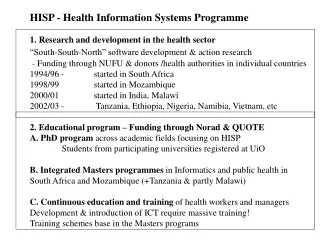
HISP Background • Health Information Systems Programme • global network of various entities • Universities, Ministries of Health, International agencies, in-country implementing agencies • established, managed and coordinated by the Department of Informatics, University of Oslo • development of the open source and free software District Health Information System (DHIS) • 22 countries in Africa are using DHIS
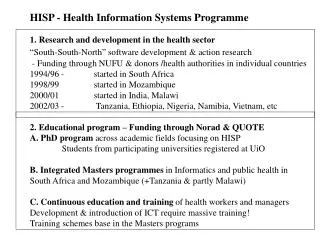
2001-2009 Universityof Western Cape 1. Public health Eduardo MondlaneUniversity 2. Public health Universityof Oslo and Eduardo MondlaneUniversity 3. Informatics 2007-2013 Universityof Dar Es Salaam 4. Health informatics Addis Ababa University 5. Health informatics GondarUniversity 6. Public health Universityof Malawi 7. Public health 8. Informatics Colombo University 9. Public health Masters Programmes
PhDProgramme • PhD education at University of Oslo. • Students include university lecturers and implementing partners • Fieldwork conducted in home country • 14 graduated
DHIS 2 Academy • Aims to build capacity on setting up and maintaining the DHIS 2 software. • Basic and advanced levels of training • Conducted at regional level
On-going Research Projects • Maternal and Child Health Information Systems • Birthregistrationsystems at communitylevel • Patientcareinformation systems in rural settings • Mobile Health systems • Using mobile phones to report data from facilities
Capacity Needs • Users • Health workers- general IT and Health informatics • Non-medical staff- health domain knowledge • Service Managers & Supervisors – Health informatics • HIS/M&E officers (statisticians)- health informatics, system administration • System customizers/implementers • Health domain, System administration • System Developers • Health domain
Research and educationneeds • In-service training for the different types of users • Certificate/diploma • Explore use of electronic media • Pre-service training for health workers • Integrate in health colleges/universities • HIS courses for developers
HISP webpage www.mn.uio.no/ifi/english/research/networks/hisp/ DHIS 2 website http://www.dhis2.org/